
Equipment purchasing
Buying equipment from China for Hawaii: a specification checklist
Two suppliers send you a photo of a similar machine. Both list the same model name; one price is lower. Before deciding which offer is better, find out what each factory will actually build. Buying equipment from China for a Hawaii farm or business starts with a written specification that both parties can check. The useful document describes the job, the configuration and the evidence you need before the machine is packed—not just the model number.
Start with the work the machine has to do
Write a short description of the material or product you will handle, its size range, the required output and how the machine will connect to your existing workflow. A conveyor moving empty harvest baskets and one moving filled containers may look alike in a catalog. They are different purchasing requirements. Ask the supplier to confirm the intended load and operating conditions rather than leaving them to infer your needs from a photo.
When a supplier quotes a capacity, ask what the figure measures and under what conditions it was obtained. Is the output per hour, per cycle or per batch? Does it include loading, changeovers or cleaning? Put the units and test conditions beside the number. A maximum catalog figure with no operating basis is difficult to compare with another factory’s offer.
Keep site questions in the same brief: available floor area, interfaces with existing equipment, indoor or outdoor use, and the way the machine will be cleaned or maintained. Ask the supplier to identify any limits that affect the intended use. This brief is a request for confirmation, not a substitute for a technical assessment.
- Material or product, size range and intended load.
- Target output, units and the conditions under which it will be checked.
- Working space and required inlet, outlet or mounting interfaces.
- Operating environment and cleaning / maintenance needs to review with the supplier.
Turn the model name into an agreed configuration
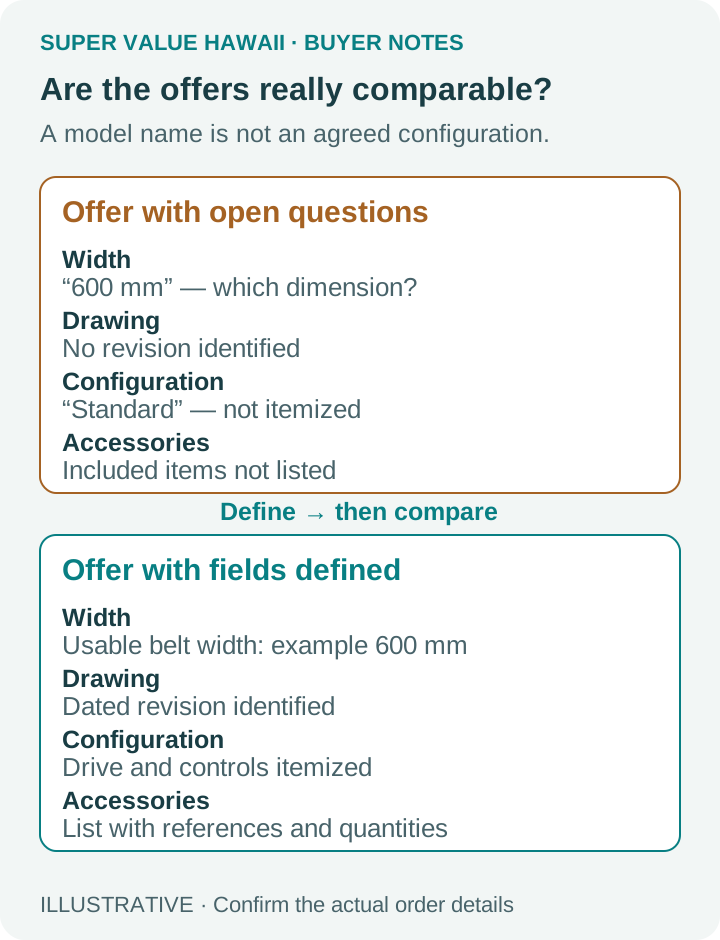
Request a dated drawing or specification revision for the exact offer. Include the machine’s main dimensions, working dimensions, materials where relevant, drive and control arrangement, adjustment range and the accessories supplied. Distinguish overall dimensions from useful working space. “Width” could refer to the outside frame, a belt or the opening through which your product must pass.
For example, an illustrative conveyor inquiry might say “600 mm wide.” Before comparing offers, specify whether that means usable belt width or overall frame width, and ask for the corresponding drawing. An offer that leaves the meaning open cannot yet be compared with one that defines the usable width. The number is an example of an ambiguous specification, not a product specification or customer order.
Keep one final revision that the supplier has acknowledged. If a motor, controller, material or accessory changes, ask for a revised specification and review the consequences before production or dispatch continues under that change. A substitute can affect more than the purchase price: documentation, service parts and the receiving plan may also need updating.
Confirm electrical and utility requirements for your site
For powered equipment, ask for the complete machine’s rated supply requirements, including voltage, frequency, phase and the relevant current or power information. Have the supplier identify the requirements of its controls and accessories as well as the motor. If the machine also needs compressed air, water, drainage or another utility, request the required supply conditions and connection information.
ABB’s motor-nameplate guide, linked below, explains that voltage, frequency and phase describe different aspects of a motor’s electrical requirements. Collect all of them. A voltage label alone does not establish that the whole machine suits your site, and a motor label does not describe every component in the machine.
Give the machine specification and manufacturer’s documentation to the qualified person responsible for installation at your Hawaii site. Ask them to assess compatibility before the configuration is finalized. Do not treat an adapter, transformer or replacement motor as an agreed solution merely because it was suggested in a chat. Any proposed change needs review of the complete equipment and installation requirements.
- Machine supply specification and clear photos of relevant nameplates, when available.
- Manual and connection information for the exact configuration.
- Utility requirements, with units and the scope of connections to be provided.
- Unresolved site-compatibility questions identified before the order configuration is approved.
Choose the evidence that would answer your buying questions
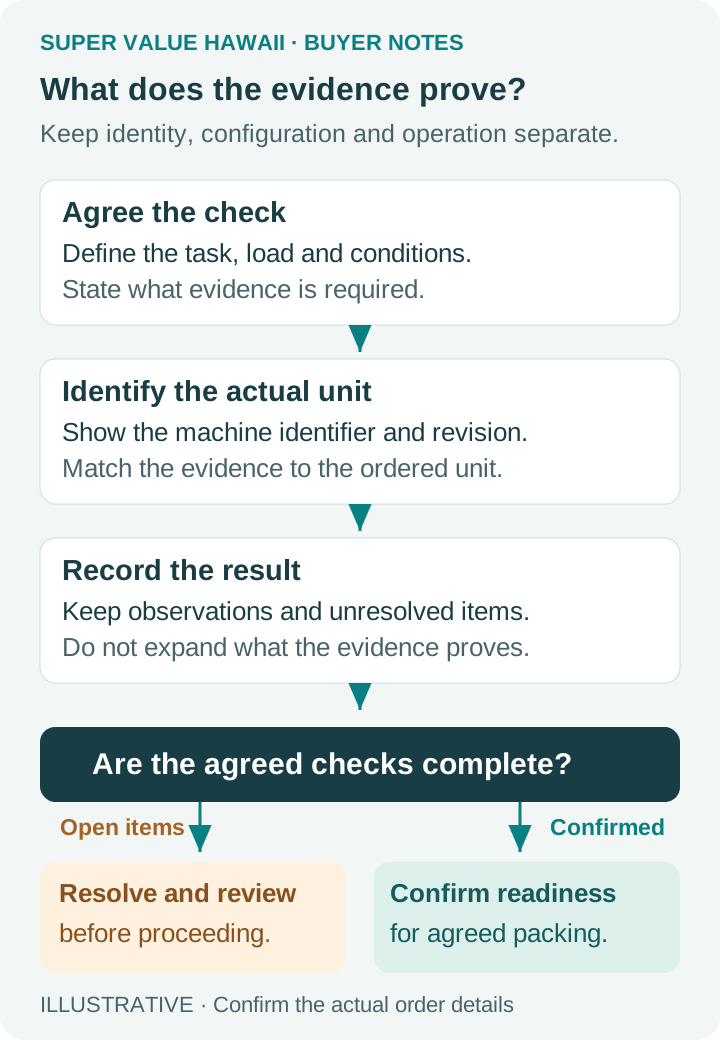
Agree what will be checked before packing and how the results will be recorded. Separate identification, configuration, accessories and operation. A photo can show a nameplate or a supplied attachment. It cannot establish production output, long-term reliability or the suitability of the machine for every material you plan to use.
Ask for evidence tied to the actual unit: the machine identifier, the agreed revision, the material used in the demonstration and the conditions of the test. For an operational demonstration, define the task and the observation you need. An empty conveyor running for a short clip answers a different question from a demonstration with the intended load; neither should be represented as more than it shows.
If an independent inspection is needed, agree its scope and responsibility separately. A factory demonstration, an inspection report and commissioning at your site are different checks. None automatically includes the others. Put unresolved results or missing evidence in writing, and agree what happens next instead of silently treating them as accepted.
List the parts, documents and support you are buying
Ask for an itemized accessory and spare-parts list with quantities and part references. Separate standard items, optional items, consumables and anything to be purchased later. Identify which parts are needed for first installation and which are sensible operating spares. Ask how replacements will be identified and ordered; a promise of “spares available” is less useful than a documented part number and contact process.
Confirm the manuals, drawings, software or control documentation included where relevant. Ask what support covers: remote diagnosis, replacement parts, installation assistance or on-site commissioning. Clarify who provides it and how an issue will be reported. Do not assume international shipping, labor or a local service visit is included in a warranty statement.
Use a simple comparison sheet for each supplier: requirement, offered configuration, evidence supplied, included items and open questions. Leave uncertain cells marked “to confirm.” A lower offer can remain a valid choice, but you need to know whether it omits something the other offer includes.
Connect the final specification to the Hawaii shipment
After the configuration is agreed, obtain packing details for that version of the machine and its separately packed accessories. Shipping estimates based on an earlier drawing may need review if the machine or packaging changes. Link the package IDs back to the order so the receiver can tell which crate contains which item.
For a shared container shipment to Hawaii, the confirmed packing, handling requirements, cargo readiness and actual available space determine whether the equipment fits the plan. Supplier agreement on a machine specification does not reserve container space or establish a sailing date. Review the shipping arrangement as a separate step.
Send Super Value Hawaii your intended use, supplier offers and the specification questions still open. We can review equipment sourcing and China-to-Hawaii shipping requirements together. Customers on all Hawaiian islands can be assessed; transport and destination costs are confirmed separately for the cargo and island. Use the inquiry link below and keep private supplier or site contact details in that inquiry.
- A single dated specification / drawing revision acknowledged by the supplier.
- Configuration, utility questions, included items and evidence requirements recorded.
- Any missing evidence or proposed substitution resolved or explicitly left pending.
- Final packing information matched to that configuration.
- Shipping and destination scope assessed separately from the equipment purchase.