
Equipment purchasing
Factory test videos: checking machine output for a Hawaii order
Suppose your supplier quotes 120 units an hour and sends a short clip of the machine running. Before you order equipment from China for Hawaii, ask what that factory test video establishes. You need to connect the quoted rate to the actual configuration, the material used and a recorded test period. A few finished pieces on camera leave several buying questions open.
Tie the demonstration to your proposed machine
Ask the supplier to identify the machine in the recording and match its configuration to the offer revision. Record the tooling, attachments and controls used. A demonstration of another unit can help explain a process, but keep its identity clear; it does not confirm what was built for your order.
Describe the material or product used during the demonstration. Record the size, condition and other characteristics that affect the intended task. If the factory uses a substitute because your material is unavailable, ask the responsible technical reviewer what can be concluded from that substitution. Leave the unanswered part of the requirement pending.
Give the output figure a time window
Write down what counts as one unit of output. Completed pieces, accepted pieces, cycles and material fed into a machine describe different quantities. Agree the acceptance criteria for the output before comparing a result with the supplier’s quoted capacity.
Ask when the recorded period starts and ends, which activities it includes, and whether any footage has been removed. Log setup, feeding, clearing, changeovers and stoppages where they fall within the agreed test scope. Keep the elapsed period and the accepted output beside the calculated rate.
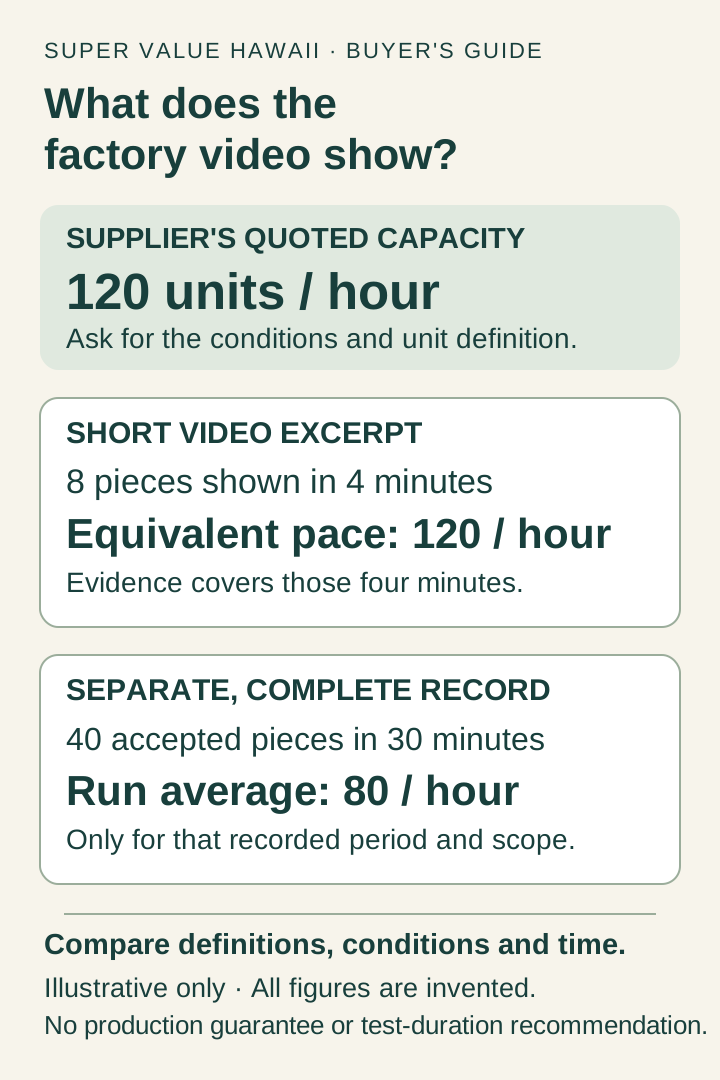
A fictional paperwork example illustrates the difference. A four-minute excerpt shows eight completed pieces: 8 ÷ 4 × 60 gives an equivalent pace of 120 pieces per hour. A separate, complete 30-minute record shows 40 pieces meeting its stated acceptance criteria: 40 ÷ 30 × 60 gives an observed average of 80 accepted pieces per hour. The figures use an hourly unit, but cover different periods and may count different output. Compare the conditions and definitions before comparing the rates.
All figures in this example are invented. Neither record predicts a full shift, and the example prescribes no test duration, output target or machine operating method.
Ask for the record behind the clip
Request a test note that lets the reviewer trace the result to the source files. A continuous recording may make the sequence easier to follow, but a camera view alone may not show every condition or rejected piece. Ask the supplier to identify gaps and explain how the counts were obtained. Keep a stated result separate from a result supported by the agreed evidence.
| Review item | Question to record |
|---|---|
| Machine and revision | Which unit and offer or drawing revision? Identify configuration differences and the source of any example footage. |
| Material and task | What product or material was used? Which intended conditions were represented, substituted or left untested? |
| Output definition | What is counted, in which units? Who agreed the criteria for acceptable output, and how are rejected items recorded? |
| Time and interruptions | What are the start, end and elapsed time? Which setup, feeding, changeover or stop periods are included or omitted? |
| Evidence and result | Which video, count sheet and test note support the result? Record who performed the check and any limits on the evidence. |
| Open items and retest | What remains unresolved, who will answer it, and which changed conditions require a new review or test? |
A buyer’s information record. The supplier and responsible technical reviewer should agree the safe test method, criteria and evidence for the particular machine.
Keep the factory video and acceptance decision separate
SGS describes factory acceptance testing as including functionality, requirements and document checks. A supplier’s video can contribute evidence to an agreed review. Calling the file “FAT passed” does not tell you which checks were performed or who reviewed the findings.
Ask who will perform or witness any required test, what its scope covers and how exceptions will be reported. Record an unresolved result explicitly. A revised configuration or a different test material may require another review. Factory evidence also leaves installation and commissioning at the Hawaii site to be assessed separately.
Use a request the supplier can answer
Send the requirement with the exact offer revision and the question you need the demonstration to resolve. Keep the request about evidence; let the supplier and responsible technical personnel define and conduct the machine test.
For the machine in offer [reference/revision], please identify the unit, configuration and test material in your video. Please provide the test note with the output definition, acceptance criteria, elapsed period, accepted and rejected counts, and included or omitted interruptions. Please identify any edited sections, untested conditions and open items for review.
Once the configuration and remaining questions are recorded, request the final packing details for that version. A demonstration or test record does not reserve shared container space to Hawaii. Cargo suitability, readiness and actual available space still need a separate shipping assessment.
Send Super Value Hawaii your equipment requirement, the supplier’s offer and the questions still open. We can discuss procurement coordination and the China-to-Hawaii shipment together. Use the inquiry below for private files and contact details; island arrangements and costs are assessed separately.