
Equipment purchase records
Equipment from China to Hawaii: check the manuals before shipment
The supplier sends a folder called “manuals” just before packing. It contains a brochure, an unreadable wiring image and instructions for a similar model. Before equipment leaves China for Hawaii, check what is inside the folder and which documents actually describe your machine. A file received is not yet a question answered.
Start with the machine identity, not the file name
Create a short document index against the order reference, model and agreed configuration. Add the unit’s serial number when assigned. Ask the supplier to confirm the applicability of each manual or drawing, including selected options and separately supplied accessories. Record a revision or issue date where available; if the document has no identifier, ask how it will be distinguished from a later replacement.
A model name on a PDF cover can be a starting point, but look for a clear connection to the purchased unit. Ask about different factory and seller model numbers rather than guessing from appearance. Grizzly’s own support material shows how some factory numbers map to its marketed models. That is a manufacturer-specific example of an identification problem, not a cross-brand compatibility list.
Keep supplier confirmation with the index. If an old manual is supplied with an addendum, ask which parts of the original remain applicable and which pages the addendum replaces. Do not silently discard either record.
Request documents by the question they need to answer
Agree the deliverables with the supplier while the order can still be clarified. The list below is a starting point for discussion, not a claim that every machine needs every document or that the folder establishes import eligibility. Let the people responsible for installation, operation and maintenance identify what they need.
- Installation and layout: what site information, assembled dimensions, connections and preparations must the installer review?
- Operating instructions: which controls, procedures and limitations apply to the supplied configuration?
- Maintenance information: which inspections, consumables and service procedures need the manufacturer’s instructions?
- Parts information: which drawings and orderable references describe the actual components?
- Separate accessories: which purchased items have their own manuals or installation requirements?
- Support records: who answers a technical question, and how should the unit and document revision be identified?
Grizzly distinguishes manuals from separately available specifications and parts lists in its support guidance. Its documents illustrate the range of information that may be available; their availability does not establish what another supplier has agreed to deliver. Ask that supplier for a concrete index.
Check whether the files are usable before the crate closes
Open each promised file. Check that pages are present, diagrams and labels remain legible at a useful size, and the document can be accessed by the people who will use it. A screenshot of a drawing may omit its legend or revision box. Ask for a complete, readable copy rather than trying to reconstruct missing information.
Record the supplied language and ask the intended operator or installer whether it is usable for their task. If a translation is needed, agree who provides it and who checks technical meaning. A translated title does not prove that warnings, procedures or diagram labels have been correctly translated. Keep the source and translation linked, with their revisions.
For files delivered through a temporary link, ask how the agreed documents will remain available after shipment. Save copies you are permitted to retain in the order record. Do not place private supplier files on a public website or share restricted material outside the people authorized for the job.
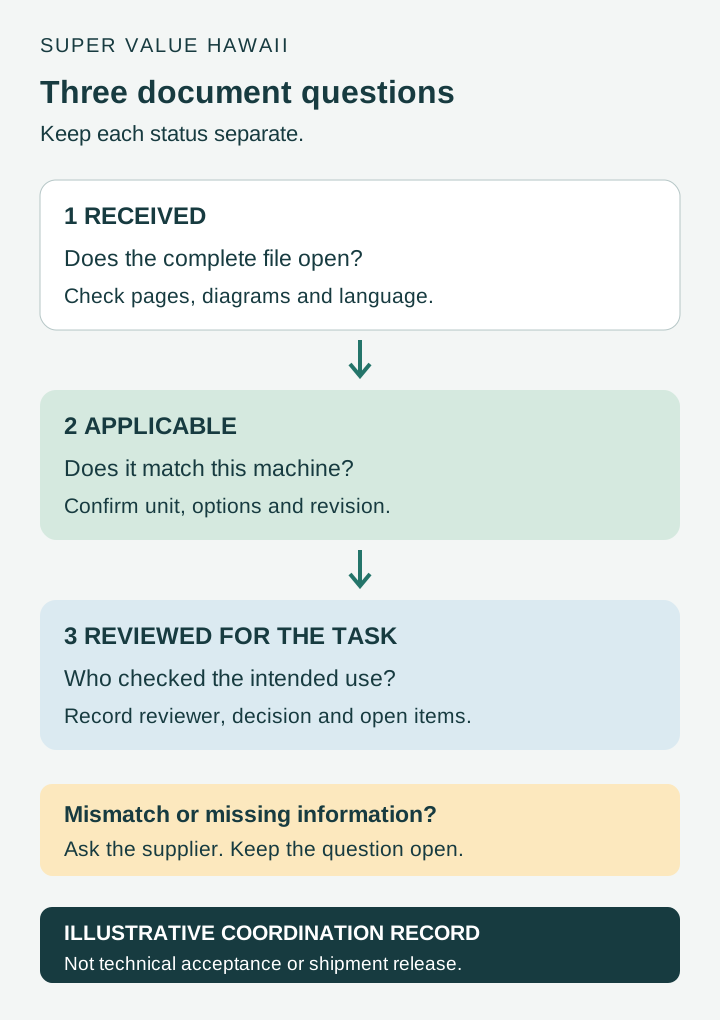
Keep an unresolved document unresolved
Use separate status fields for received, applicability confirmed and reviewed for the intended task. Name the reviewer and record the question or conclusion. “Manual received” should not automatically become “electrical connection approved” or “operator training complete.”
Consider a fictional order with controller B, while the wiring document identifies controller A. Record the conflict against the unit and both references. Ask the supplier for the applicable document or an explanation of the difference. Have the responsible technical reviewer assess the response; do not select a diagram because its title resembles the machine name.
The same approach helps with a missing service interval, an unidentified accessory or an incomplete page. State exactly what is missing, who must answer and whether the gap affects the next planned action. A shipping coordinator should not convert a missing technical answer into acceptance.
Make the handover useful to the receiving team
Keep the final index with the purchase record and give the receiving team the documents they need within the agreed access scope. State where any physical manual is packed and distinguish it from the digital set. Check that both refer to the agreed unit and configuration.
A practical index can have one line per document with these fields: purpose, file name, document number or date, applicable machine or accessory, supplied language, supplier confirmation, reviewer and open question. Add a final checked date so later configuration changes trigger another comparison.
- List the promised files and identify missing items.
- Obtain confirmation that each document applies to the supplied unit.
- Check readability, completeness and language with the intended user.
- Resolve conflicting versions with the supplier and responsible reviewer.
- Retain the final index and hand it over with the equipment records.
Keep the document review separate from freight release
If a document gap must be resolved before collection, make that requirement explicit in the order follow-up. Record who decides whether the response is adequate. A completed document index alone does not verify machine performance, cargo packing, customs requirements or readiness to ship.
For a sourcing discussion with Super Value Hawaii, send the model and intended use, your destination island and a summary of missing or conflicting information. Transport assessment also needs package dimensions, gross weights, counts and the proposed handover scope. Specialist technical review, training and installation services require a separately confirmed scope.