
Equipment sourcing
Before ordering China equipment: an electrical data sheet for Hawaii
The supplier offers a “US version.” The quotation gives a motor size. Your installation person asks for the machine’s electrical drawings. These are different pieces of information. Before ordering equipment from China for a Hawaii site, put the proposed machine and the intended installation point on one electrical data sheet, with evidence for each entry.
Start with two records, not a country label
Use a machine record supplied by the manufacturer and a site record checked by the qualified person responsible for installation. Keep them separate until that reviewer has compared them. “For Hawaii,” “American voltage” and “US version” do not identify the exact configuration being offered.
Ask the supplier to identify the model, quotation revision and proposed electrical configuration. Ask your installation reviewer to document the intended connection point and any information still needed to assess it. A building address alone cannot answer those questions. Do not open electrical panels or take measurements yourself to complete this procurement worksheet.
Our broader equipment specification checklist covers the buying decision. This sheet handles the next step: linking each electrical requirement to a document, a reviewer and a resolved or open question.
Compare the same fields on both sides
ABB’s motor-nameplate guide identifies voltage, frequency and phase as separate fields. It also explains that alternate frequency ratings can have different associated parameters. Copy the complete applicable rating rather than extracting a voltage number from one row and a frequency from another. The guide concerns motors; it does not establish the requirements of your complete machine.
For each field below, keep four entries: manufacturer’s requirement, site information, supporting document and reviewer’s disposition. Write “not supplied” or “not yet checked” where evidence is missing. A blank cell can too easily be mistaken for agreement.
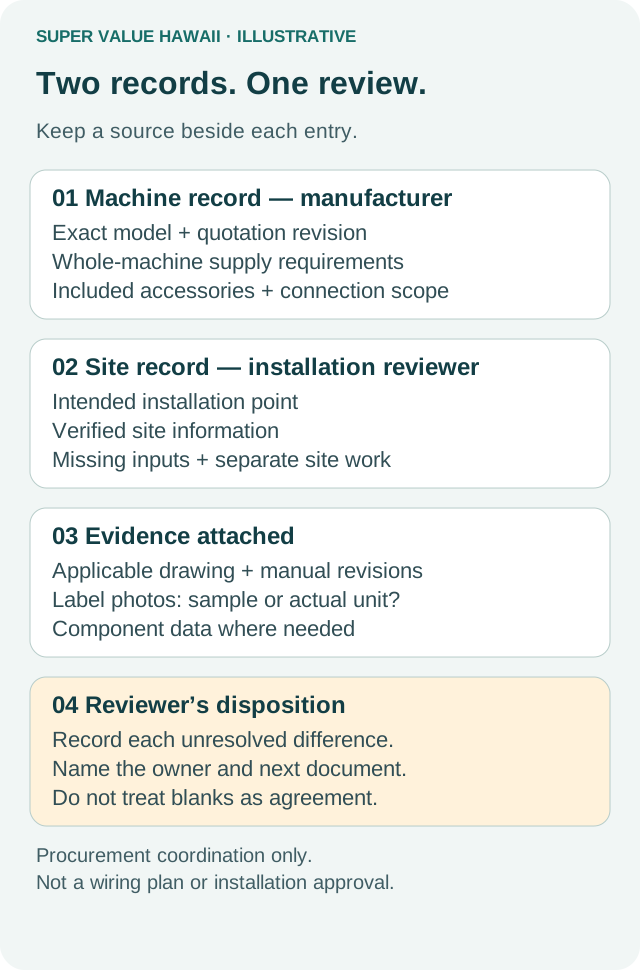
- Identification: exact machine model and configuration; quotation number, date and revision; serial number once the actual unit is allocated.
- Supply: specified voltage, frequency in hertz (Hz), and phase for the configured machine. Preserve any alternate ratings and the conditions attached to them.
- Load information: the manufacturer’s whole-machine electrical data and stated operating conditions. Keep a motor’s individual rating labelled as motor data.
- Connection information: installation manual and electrical drawing with revision identifiers, plus the manufacturer’s stated connection requirements for the offered unit.
- Included equipment: identify which controls and accessories are covered by the main machine documents, and which need separate documentation or connections.
- Site review: intended installation point, information verified by the installation reviewer, unresolved requirements, and any site work to be separately assessed and quoted.
Ask what the motor photo leaves out
A motor photo is useful evidence for that component. Ask whether the quoted machine also includes a control cabinet, drive, heater, pump or other powered accessory, and which drawings describe them. The point is to establish the scope of the documentation, not to assume that every machine has those components.
For a machine with several components, request a short component register: component name, identifying model, relevant rating or data sheet, drawing reference, and whether it is included in the quotation. Ask the manufacturer to state which supply requirements apply at the machine’s external connection points.
Do not create a whole-machine figure by adding unlike ratings yourself. Pass the component documents and manufacturer’s machine data to the installation reviewer, who can identify what is missing and request the information needed for assessment.
Keep a disagreement open until the documents agree
Illustrative situation: the quotation says “US version,” a photographed motor label shows one rating, and the attached manual describes a different configuration. Those documents do not yet describe one clearly identified purchase. Record the conflict instead of choosing whichever document looks most favorable.
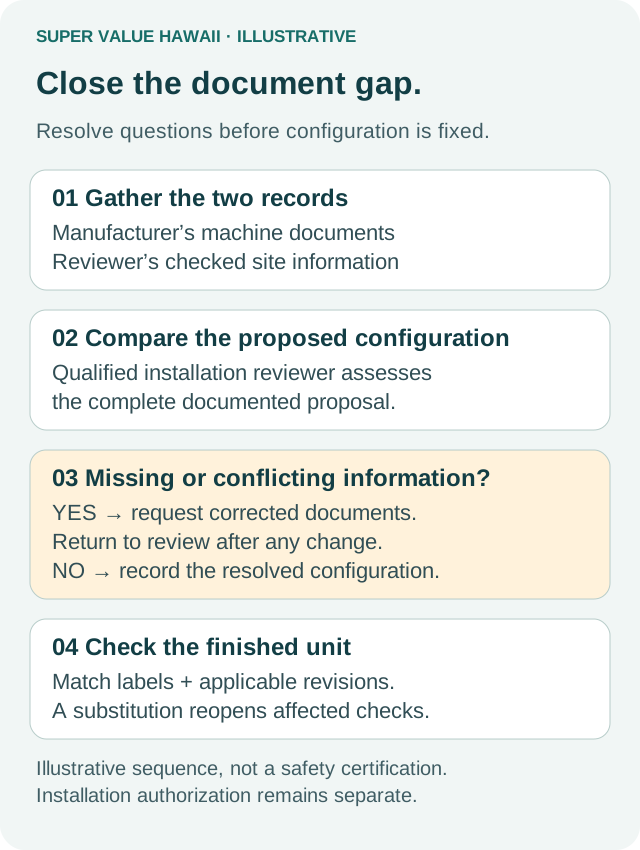
Ask the supplier whether the photo is of the offered unit, a sample machine or another version. Request a corrected configuration statement and the applicable drawing or manual. If the proposal changes, obtain its effect on price, included equipment, preparation time and documents in writing before deciding to proceed.
A proposed transformer, drive change or motor replacement is a separate proposal to review. Have the manufacturer document the complete revised configuration and let your qualified installation reviewer assess it. A chat message naming a component does not close the discrepancy.
Tie the final answer to the unit that will ship
Once the manufacturer and installation reviewer have resolved the questions, keep the agreed configuration with the purchase record. Identify the drawing and manual revisions, included accessories, outstanding installation work, and who is responsible for each next step. Keep procurement confirmation and installation authorization distinguishable.
Before collection, request legible photos of the finished machine’s identification and relevant labels, with the applicable documents. Compare these with the agreed record. If the supplier substitutes a component or changes the configuration, reopen the affected review instead of carrying forward the earlier answer.
Keep the final data sheet available to the Hawaii receiving and installation team. Packing dimensions and transport arrangements can be assessed alongside this work, but an electrical question should not disappear merely because the crate is ready.
A supplier request you can copy
Send this after inserting your model and quotation reference. Attach the site information your installation reviewer has approved for sharing; leave out unrelated building or account information.
For machine [model], quotation [number / revision], please confirm the complete electrical configuration being offered. Provide the whole-machine supply requirements, electrical data, installation manual and electrical drawing with revision identifiers. Identify the included powered accessories and any separate connections. Please distinguish sample photos from the actual unit. Our installation reviewer will compare these documents with our site information. Please list missing information, exceptions and any proposed configuration changes rather than confirming only “US version.”
Super Value Hawaii can coordinate equipment sourcing and supplier document requests. Send the proposed model, quotation and the specific documents you need through our sourcing inquiry form. Electrical suitability, installation scope and any applicable approval requirements need assessment by the appropriate qualified parties for your actual equipment and site.