
Equipment procurement
Pre-shipment photos for equipment from China to Hawaii
Suppose your supplier sends three photos and says your machine is ready to ship. One shows the front, one shows a closed crate, and one shows a running machine with no readable nameplate. Before arranging a China-to-Hawaii equipment shipment, ask for a photo record you can match to your order. Start with the actual unit, follow its accessories into the packing, and keep unresolved questions beside the evidence.
Give every photo a reference you can follow
Ask the supplier to put the purchase-order reference, machine model and current configuration revision on the evidence index. Record when the images were taken. Add a readable nameplate photo and the serial number when one has been assigned. A catalog image or a photograph of a similar unit should be labelled as a reference, then replaced with evidence of the unit intended for your order.
Use a short index with one row per checkpoint: the requirement, photo or video filename, supplier explanation, reviewer and status. Keep the original files alongside it. A simple filename such as PO-EXAMPLE_unit-A_nameplate_2026-10-07.jpg can work; this is an illustrative naming pattern. Where an attachment has its own model or serial number, give it a separate entry.
Have the supplier show the identifying plate and the whole unit in a continuous walk-around where practical. This helps you relate close-ups to the equipment being discussed. It does not independently authenticate the footage or prove that the unit performs as specified.
Request a sequence from the unpacked unit to the finished package
Arrange the photo request before packing starts. Once a crate is closed, the supplier may need to reopen it to answer a question about its contents. Ask for the following groups in sequence, with matching order and unit references.
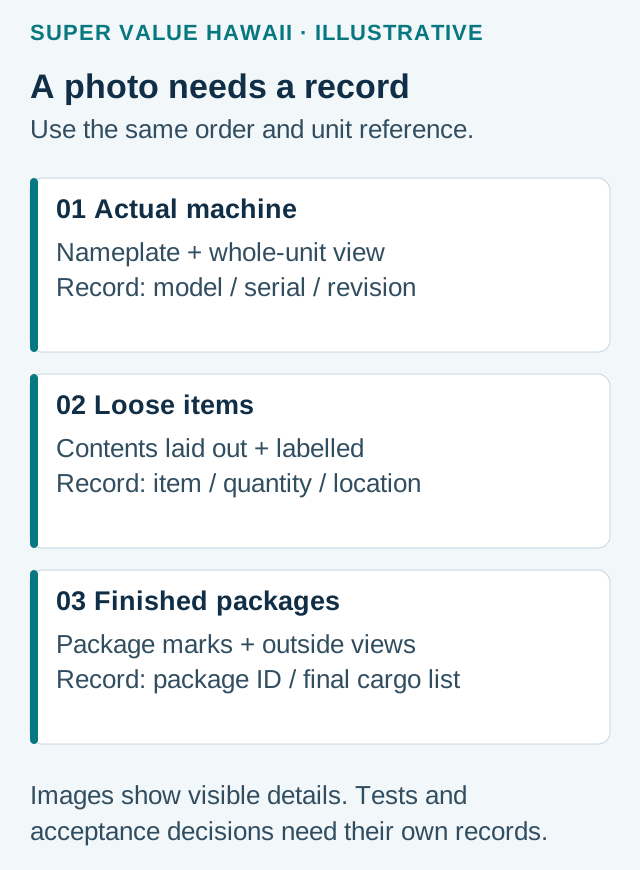
- Identity: readable nameplates, the whole machine and identifiers on separately supplied attachments.
- Agreed configuration: views of the specific components and connection points listed in your order; label close-ups so their location is clear.
- Loose items: accessories, manuals, installation items and spare parts laid out against the agreed contents list, with quantities recorded.
- Before closing: the machine and loose items in their packing locations, including the identifiers of any inner boxes.
- Finished packages: each package mark, all accessible sides and final outside dimensions, with a cross-reference to the packing list.
For dimensions, ask for a measurement view that shows the relevant edges and units. A tape laid on the machine alone cannot establish the outside size of its finished crate. Obtain the final gross weight as a recorded figure too; a photo cannot establish it by appearance.
Keep a running video beside the agreed test record
A machine running without material may show movement, but it leaves questions about output under your intended conditions. If performance matters to the purchase, agree the test procedure, material or load, duration, measurements and acceptance criteria with the supplier and a qualified technical reviewer before the test.
Ask for footage tied to the actual unit and a written record stating what was tested, the conditions and the results. If the factory could only demonstrate part of the agreed requirement, record that limitation. Avoid treating a brief clip, a control-screen number or the supplier’s “passed” message as evidence for every specification.
SGS lists visual inspection, documentation review, packing checks and witnessed tests within its pre-shipment inspection services. That scope shows the range of checks that can be arranged. A supplier photo review covers only the evidence you actually receive; independent inspection or test witnessing needs a separate agreement.
Make discrepancies specific enough to close
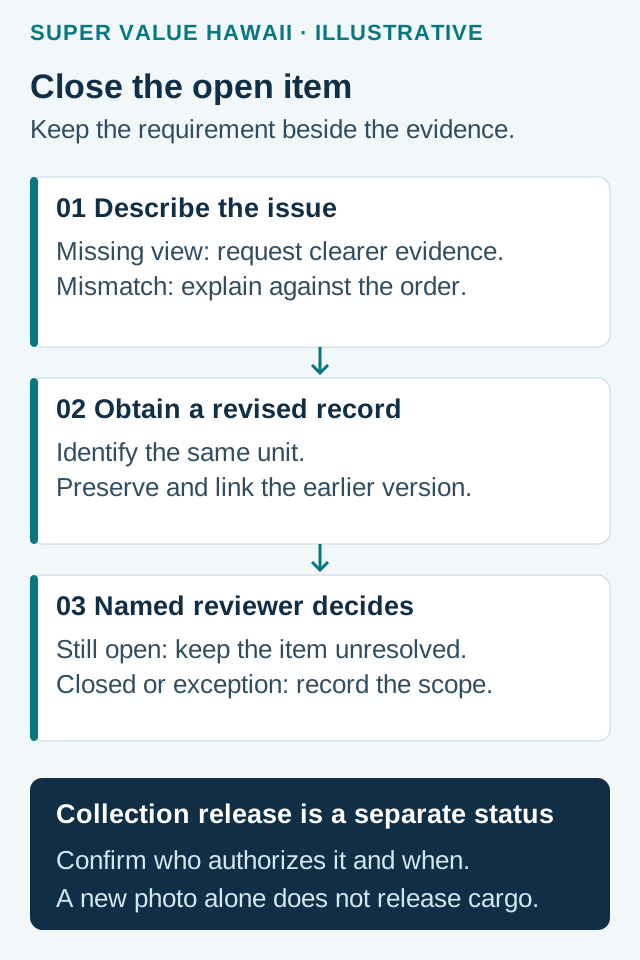
Use an open-item list when the record is incomplete or contradicts the order. Distinguish a missing view from an observed mismatch. “Nameplate unreadable” requires clearer evidence. “Plate shows a different component model” requires an explanation against the agreed configuration, then a decision by the person responsible for acceptance.
For each item, record the requirement, what you received, the question or discrepancy, who will respond, and the evidence needed to close it. After a correction, ask for new images or results that identify the same unit. Preserve the earlier record and mark which file the revision supersedes.
For example, your order lists a machine and two attachments. The supplier sends a machine photo and one attachment photo. Ask whether the second attachment is unfinished, packed elsewhere or omitted from the photo set. These possibilities lead to different shipment decisions. This is an illustrative scenario, not a customer case.
Record product review and collection release separately
Keep separate fields for product-review status, packing complete, final cargo details and collection release. A machine can be photographed and still have an open technical question. It can also have an accepted product record while its crate dimensions remain estimated.
Confirm who has authority to accept the product evidence and who tells the supplier it may release the cargo. If there are open items, state whether collection must wait or whether a particular exception has been explicitly accepted. Record the scope of that decision. Shipment coordination should not silently become technical acceptance.
When several suppliers are contributing to a shared container plan, carry these statuses into the supplier list. Updated readiness information helps assess the plan, but does not establish available container space or a confirmed departure. Cargo suitability, actual space and timing still need assessment.
Send a precise request to the supplier
Adapt this request to your order. Add the checkpoints from your agreed specification and nominate the person who will review the response.
Please send a pre-shipment evidence index for order [reference], unit [model/serial when assigned], configuration [revision]. Include dated photos of the actual unit and its nameplates, the agreed components, all loose items against the contents list, packing before closure, and each finished package with its package ID. Cross-reference files to the order and packing list. For agreed functional checks, attach the test conditions, recorded results and unit-linked video. List any substitutions, missing evidence or open items separately. Please confirm packing status, final cargo details and whether collection release is still awaiting our review.
For a sourcing and shipment discussion with Super Value Hawaii, send the order specification, evidence index, open-item summary and proposed packing details. Tell us which Hawaiian island the cargo is intended for. Keep private supplier contacts and delivery details in the inquiry process. We can discuss coordination and the shipment information needed; specialist inspection, testing and technical acceptance scopes must be confirmed separately.