
Used equipment & purchase checks
Buying used equipment from China for Hawaii: condition records
A used machine looks tidy in the listing, and the seller says it runs well. Before committing to a China-to-Hawaii purchase, find out which machine the listing represents, what has actually been checked and what remains unknown. A used-equipment condition record gives you a place to compare the seller’s answers with dated evidence and inspection findings.
Identify the actual used machine
Start with a model and serial number, the manufacturer’s plate and dated photographs of the offered unit. Ask whether the listing photographs show that unit or another machine. Record the installed attachments, controls and major options; a model name alone may cover several configurations.
Keep a reference tying the seller’s quotation, photographs and inspection report to the same machine. If the seller substitutes a different unit, review the evidence for the replacement. An earlier report cannot establish its condition.
Ask how the machine will be supplied: assembled, partly dismantled or with attachments packed separately. Identify every included item in the purchase agreement. This affects both what the inspector can check and the later package count.
Separate the seller’s account from the evidence
Request the maintenance and repair history, known faults, recent alterations and records supporting the stated usage. Photograph the hour-meter reading where applicable, with the unit reference and date. That records a displayed reading; verifying the machine’s operating history requires supporting records.
Caterpillar’s used-equipment buying guidance recommends requesting records such as maintenance history, replacement parts, service hours and incident reports. Its certified-used inspection description also separates configuration review, physical condition checks and operational tests. These are examples from Caterpillar’s own materials. They do not establish certification or an inspection standard for a machine offered by another seller.
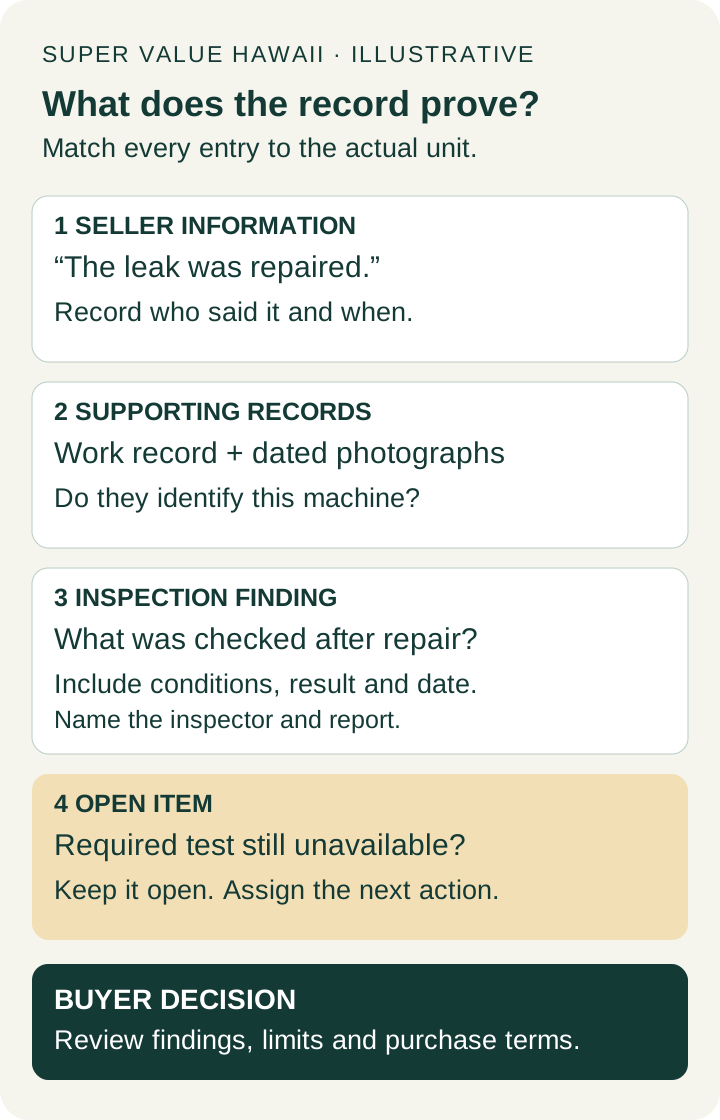
Use a separate field for each kind of information. “Seller says the hydraulic system was repaired” belongs under seller information. The repair invoice belongs under supporting records. An inspector’s dated findings belong under inspection results. Missing records should stay visible as missing.
Agree what the inspection will cover
Choose an appropriately qualified inspector for the equipment and agree the scope before the visit. Ask which systems and functions can be examined, what operating conditions are needed, and what the report will leave untested. The seller should confirm access, available utilities and any preparation required.
A short video of a machine idling may answer whether it starts in that recording. It leaves questions about operation under load, output quality and other functions unanswered. Specify the performance evidence relevant to your intended use and let the qualified inspector determine a suitable, safe test method.
Request findings tied to the machine’s identity, inspection date and test conditions. An overall “good” rating is difficult to use unless the report explains what was checked, what was observed and the limits of that conclusion.
- Unit: exact serial number, configuration and included attachments.
- Scope: components and functions to examine, with agreed exclusions.
- Conditions: whether checks were visual, powered or operational; the recorded load or operating conditions where relevant.
- Findings: observed condition, supporting photographs and the inspector’s remarks.
- Limits: inaccessible areas, unavailable tests and unresolved faults.
- Follow-up: what needs repair, further evidence or another inspection before your decision.
Verify a repair after it is completed
When the seller agrees to correct a defect, record the specific work, who will perform it and what evidence you require afterward. Agree who will recheck the affected function and when. Keep the purchase decision with the buyer; a seller’s “fixed” message is a status update that still needs the agreed verification.
For example, imagine an inspection records an oil leak and the seller agrees to repair it. The record should retain the original finding, the work performed and the result of the agreed follow-up check. If the required operating test could not be done, mark that test as outstanding. This is an illustrative purchase scenario, not a Super Value Hawaii customer case.
If you decide to accept an unresolved item, document that decision and its effect on the purchase terms. Ask for an updated record if the machine is repaired, modified, used further or dismantled between inspection and collection.
Check whether you can support the machine in Hawaii
Before purchase, confirm the model-specific manuals, parts references and available repair support. Ask whether replacements for altered or discontinued components can be identified. A generic parts catalog may be insufficient when a used machine has been modified.
Get any warranty or after-sales promise in writing, including the seller, coverage, exclusions and process for a claim. Clarify who pays for parts, labor, diagnosis and transport under that agreement. Treat an unanswered question as open rather than assuming the same support offered for a new machine.
Compare these answers with the equipment specifications you need at the receiving site, including power requirements and installed accessories. Refer electrical suitability and any required changes to an appropriate local professional before relying on the machine for your intended use.
Prepare the shipping review as a separate decision
Send the exact equipment name, manufacturer, model, intended use, photographs and condition details with the shipment request. Include the purchase value, supplier location, proposed Hawaiian receiving point and the final packed dimensions, gross weight and package count when available. Label estimates until the supplier supplies final packing data.
These details let the parties handling the shipment assess the cargo and determine what import documents or other checks need review. A condition report does not settle import eligibility, classification or clearance requirements. Those depend on the actual equipment and must be confirmed for the shipment.
Supplier consolidation and shared container space to Hawaii also require a separate assessment of cargo suitability, readiness and actual space. Destination transfer, delivery and unloading need their own scope and cost review; each Hawaiian island can be assessed. Keep the purchase acceptance record available to the coordinator so collection is planned against the current condition and release status.
A focused request to send to the seller
Adapt this request to the machine under consideration. Keep the seller’s reply and attachments in the private purchase file, then use the unanswered items to define the inspection and your next decision. Super Value Hawaii can assess sourcing and shipment coordination for suitable commercial cargo once the actual equipment and scope are identified.
Please confirm the manufacturer, model, serial number and installed configuration of the actual used machine offered. Send dated photographs, its available maintenance and repair records, known faults, and the records supporting its stated usage. Which operating checks can be arranged for an agreed inspection, and which would remain untested? Please list included attachments, manuals and parts information, along with any proposed repairs and the evidence available for a follow-up check.