
Cargo readiness & supplier coordination
Cargo ready dates for China-to-Hawaii equipment shipments
Your equipment supplier says the order will be ready on Friday. Does that mean the machine will be finished, the crate will be closed, or a truck can collect it? For a China-to-Hawaii shipment, agree what the cargo ready date covers before using it to plan collection or combine supplier orders. Record the remaining work and who can confirm it.
Agree the pickup-ready milestone
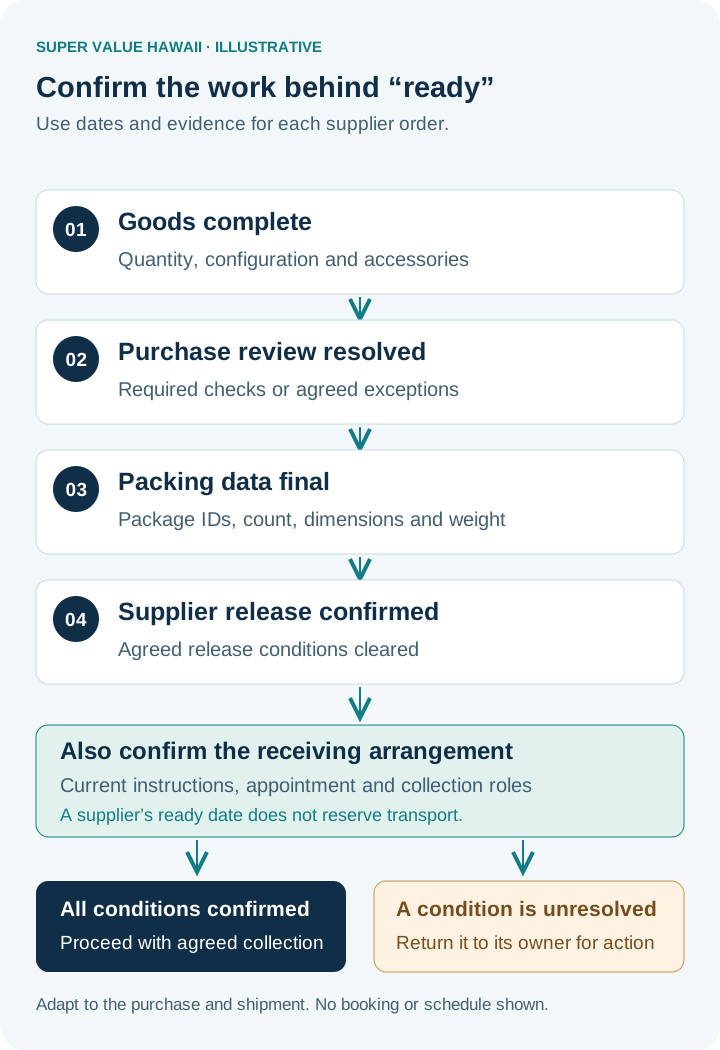
For your order, define “ready for collection” in writing: the agreed goods and accessories are complete, the required purchase checks are resolved, the final packing data is available, and the supplier has confirmed release. This is a proposed coordination checklist. The parties should adapt it to the cargo, purchase agreement and collection arrangement.
A production finish date remains useful, but packing and release may follow it. Ask for separate forecasts for unfinished work. If a check finds the wrong accessory or packing needs revision, keep that dependency visible rather than carrying the original pickup date forward unchanged.
Agree who confirms release at the factory and who authorizes the transport job. A supplier saying “available” does not show that the receiving location has accepted a delivery appointment. Confirm the current receiving instructions with the shipment coordinator before dispatch.
- Goods: the agreed quantity, configuration and included accessories are accounted for.
- Review: the purchase checks you required are complete, or a specific exception has been explicitly agreed.
- Packing: final package IDs, count, outer dimensions, gross weights and handling instructions are available.
- Release: agreed supplier release conditions are confirmed by the responsible person.
- Collection: pickup and receiving details, appointment and responsible parties are confirmed.
Keep forecasts, confirmations and actual events apart
Use three fields beside each milestone: forecast date, confirmed status and actual completion date. A forecast supports planning. An actual date records something that has happened. Leave the actual field blank while the work is unfinished.
Add the date and local time zone of the latest update, the person responsible and a reference to the supporting record. “Packing expected Friday; crate measurements pending” is a usable status. “Ready Friday” leaves the next person guessing. Use calendar dates in the live record; “tomorrow” becomes ambiguous when a message is forwarded between China and Hawaii.
The download uses one row per milestone. Keep supplier contact details and purchase references in your private order file. A dashboard status should point to the evidence without circulating private screenshots to everyone involved.
Use final packing evidence for the collection plan
Ask for the dated packing list and photographs of the finished outer packages. Match the package IDs to the measurement and weight records. If dimensions were estimated before crating, label them as estimates until the final packed measurements arrive.
The International Trade Administration describes a packing list as recording package contents, weights and measurements. Use those fields to identify the physical load. Confirm the additional documents and checks required for your shipment with the parties handling it.
A later packing revision can change the collection plan even when the machine stays the same. For example, a spare-parts carton moved outside a crate becomes a separate outer package. Update the count, measurements and handling instructions, then ask the coordinator to reassess the transport arrangement. The earlier “ready” status needs another review.
Check the dependency before waiting for a late supplier
Illustrative situation: supplier A has a packed pump released for collection. Supplier B has finished the fittings, but its packing measurements and release confirmation are outstanding. Supplier B is still an open dependency for the combined collection plan. These are invented planning examples, not customer shipments.
First establish whether the fittings are needed to install the pump or are stock for later use. Then ask the coordinator to assess the available options: hold the released goods, assess separate movement, or defer an order. Record the decision owner, the information needed and the next review date.
Confirm storage and extra-handling terms before choosing to wait. Ask where the goods would be held, who permits that arrangement, which charges apply and when they begin. Keep unresolved charges open. Supplier consolidation and shared container space to Hawaii depend on cargo suitability, readiness and actual space; a revised ready date does not reserve a departure.
Record warehouse receipt after supplier dispatch
Once goods leave a supplier, ask for the dispatch record and keep the expected arrival separate from the receiving location’s actual receipt. Track these events per supplier order when combining orders from multiple suppliers.
At receipt, obtain the package count, identification and any reported visible packing discrepancy against the current list. Resolve a missing package or conflicting reference with the responsible parties before treating that order as received in full. A count-and-condition receipt does not establish product performance or confirm that the sea shipment has departed.
Tell the coordinator which Hawaiian island and receiving point you intend to use. Destination transfer, delivery and unloading still need their own scope and cost review. All islands can be assessed; the origin readiness record does not settle those arrangements.
Send a status request that identifies the unfinished work
Use the request below with each supplier, then send the consolidated status record and final packing data with your shipping inquiry. Super Value Hawaii can assess coordination for suitable commercial cargo. Keep an unanswered item attached to its responsible party so the next decision is based on the current facts.
For order [reference], please confirm the latest status of the goods, agreed purchase checks, final packing and release for collection. For every unfinished milestone, give the forecast date, local time zone, remaining task and person responsible. Attach the final packing list, outer-package measurements, gross weights and handling instructions when available. Identify any condition preventing collection. Please confirm the collection arrangement only against the current receiving instructions.