
Shipment preparation
One machine, three packages: a packing list for Hawaii
Your order says one machine. The supplier says three packages. An accessory list mentions two more boxes. Before collecting the equipment for Hawaii, find out whether those boxes are inside a crate or travelling separately. A useful packing list gives each physical package an identity, tells you what is inside it, and lets the next person reconcile the shipment without guessing.
Separate the order quantity from the package count
Keep two counts: what you bought, and the outer units being handed over. One machine can occupy several crates. Several purchased items can also share one crate. An inner carton is a location within its outer package; if it is handed over separately, it becomes a separate handling unit for that handover.
The International Trade Administration describes a packing list as an itemized record of each package’s contents, weights and measurements. It notes that freight forwarders and customs use this information for different checks. For equipment, the practical challenge is making the record agree with the actual packing.
Use a package register alongside the item list. Give each outer unit a unique mark, then record inner boxes under their parent package. Before collection, ask the supplier and receiving warehouse which units their collection or receipt count refers to. Confirm the required document format with the party preparing the transport and customs paperwork; this coordination record does not replace the commercial invoice or establish all import requirements.
Work through one order before adding more suppliers
Here is an illustrative order: one main machine, one separate attachment, one installation set, one spare kit and six filters. The supplier packs the installation set and spare kit in two inner cartons inside the main machine crate. The attachment has its own crate; the filters travel in one separate carton.
At this handover, the outer register has three entries: CR-01, CR-02 and CT-01. The two inner cartons belong under CR-01. Adding them to the outer package count would produce five units on paper while the driver is collecting three.
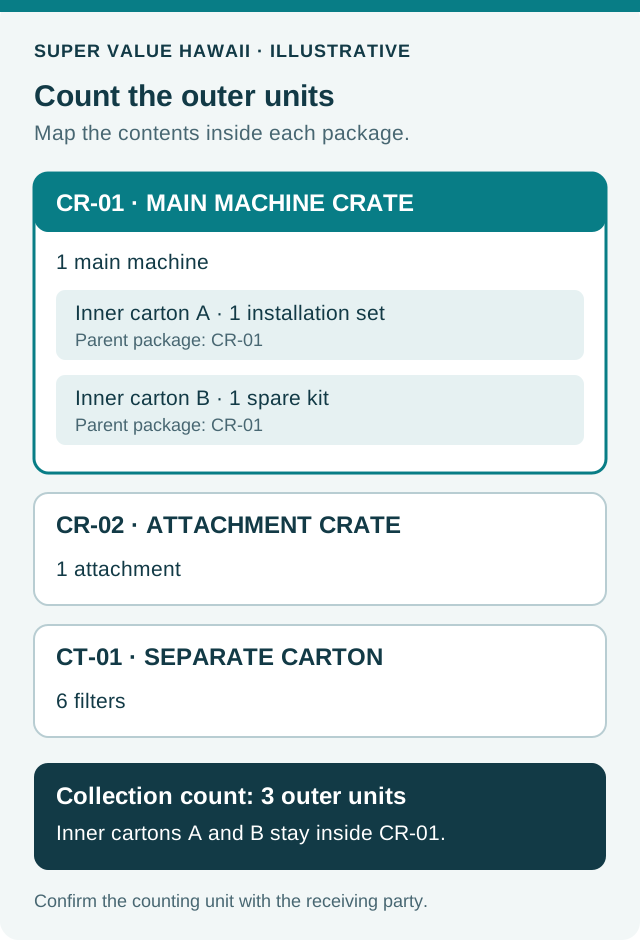
Check completeness separately: one machine, one attachment, one installation set, one spare kit and six filters. The package map tells you where those items are recorded. It does not prove that the contents were checked, or that the equipment is suitable for use. Keep a supplier confirmation and the relevant packing photos beside it.
Give every outer package a row someone can check
Ask for the finished packing list before booking collection. If the supplier sends estimates before closing the crates, label them as estimates and request a final revision. Each outer row should contain enough information to match the physical unit and understand its contents.
- Order and supplier reference: use a consistent reference on the item list, package register and evidence files.
- Unique outer package mark: a supplier or order prefix plus a package ID. Three suppliers each using “crate 1” creates avoidable ambiguity.
- Packing type and contents: crate, pallet or carton; the equipment model or attachment reference; the quantity and unit of each listed item.
- Nested contents: inner-box ID, parent outer-package ID and the items in that box. “Accessories included” is too vague to check against an agreed list.
- Final outside length, width and height: include the units and the pallet, skid or protrusions within the measured envelope.
- Gross weight for that finished outer unit: state the unit of weight. If net weight is also provided, identify what it covers.
- Handling information: record confirmed stackability, lifting or orientation instructions by reference to the supplier’s packing instructions; do not invent them from the package shape.
- Revision and evidence: document date, revision reference and the photos or weighing records that support the figures.
The physical marks should be readable and agree with the register. Ask the receiving warehouse about its label format and placement before making labels.
Add gross weights once, at the same packing level
In a second illustrative example, CR-01 weighs 420 kg gross, CR-02 weighs 95 kg and CT-01 weighs 18 kg. The outer-unit gross total is 533 kg. Suppose the two inner cartons inside CR-01 weigh 8 kg and 12 kg. Those weights are already inside the 420 kg figure; adding them again would incorrectly produce 553 kg.
Inner-box weights can still be useful for checking parts, but put them in a subordinate contents record. Do not mix them into the outer gross total. Likewise, distinguish a machine’s net weight from the weight of its finished crate. If a supplier gives only the machine weight, the packed gross figure is still missing.
Calculate volume from each finished outer unit’s measured envelope and sum those volumes. Do not add the volume of cartons already inside a measured crate. This arithmetic is a document check; it does not establish loading feasibility, permissible loads or the final charging basis. Those need a separate shipment assessment.
When packing changes, update the map before collection
A warehouse may need to split a package, combine small cartons or replace packing. As soon as the physical arrangement changes, an earlier package count or dimension sheet can become misleading. Record the change at the point where it happens, then issue a revised register.
For example, if a spare kit moves out of CR-01 into a new outer carton, give that carton its own package ID. Remove the kit from CR-01’s contents record, add it to the new row, and obtain revised measurements and weights for the affected units. Do not reuse an old gross weight as though the crate had stayed intact.
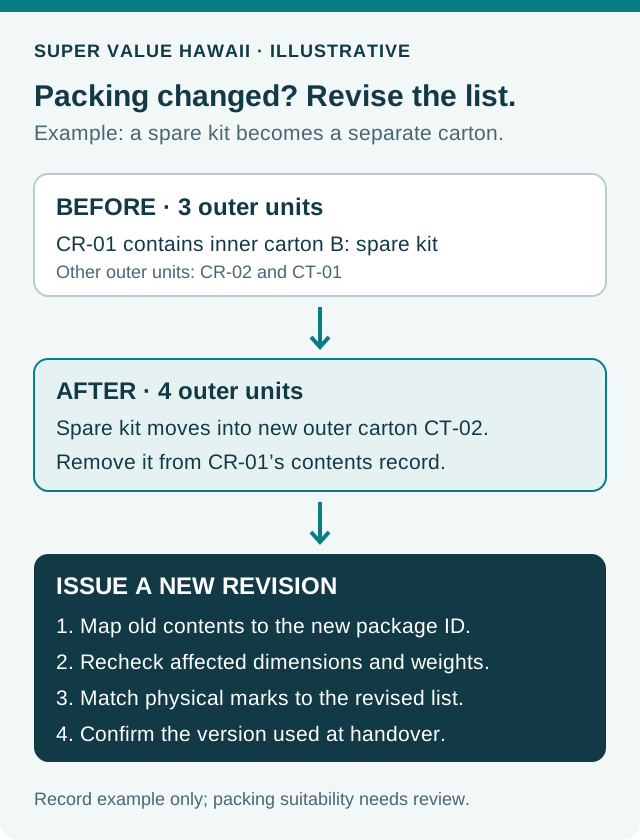
Keep the old revision with a clear “superseded” status rather than overwriting it without a trail. Send the current revision to the supplier, receiving warehouse and shipment coordinator. Ask them to confirm which version they will use at handover.
Reconcile the register at each handover
At collection, compare the readable outer marks against the current register. Record received, missing, extra, unreadable or visibly damaged units. A count of three does not establish completeness if the expected carton is missing and an unrelated carton has taken its place. Match identities as well as totals.
For shared container space to Hawaii, keep supplier and order references attached to the package records through consolidation. If a package is opened or relabelled, carry the old-to-new reference forward. Consolidation depends on cargo suitability, readiness and actual available space; a complete register helps assess the cargo but does not reserve a position.
Carry the final list into the Hawaii receiving plan. Identify the intended island, handover location and who will reconcile the units on arrival. Requests for different islands can be reviewed; onward handling and fees need a separate check. Use the unloading checklist to resolve site access and equipment needs before the cargo arrives.
- Expected marks match the units presented; exceptions are written down.
- Outer package count matches the current packing revision.
- Item quantities are mapped to the correct packages, including nested boxes.
- Gross weights and dimensions refer to the final outer units, with no nested totals added twice.
- The receiving parties have the same revision and know who must resolve each discrepancy.
Send the supplier a specific request
You can adapt this request for your order. Replace the bracketed fields and confirm the required documents with your shipment coordinator.
Please send the final packing list for [order reference], with one row per outer crate, pallet or carton. Include a unique package mark, contents and item quantities, final outside dimensions with units, and gross weight for each outer unit. List any inner cartons under their parent package. Please show where the agreed accessories and spare parts are packed, attach matching package photos, and state the document revision. If packing changes before collection, send a revised list and identify the changed units.
If the supplier cannot yet provide the final figures, keep the missing fields visible. Share the provisional register with us and tell us what is still being packed. We can review the shipment information and identify what is needed for an assessment; collection and consolidation arrangements remain subject to the actual cargo and readiness.