
Packing & cargo space
Packed dimensions and CBM: measuring equipment for a Hawaii shipment
Your supplier sends a machine drawing. The length and width look manageable, so you forward them for a shipping estimate. Then the finished crate arrives on a pallet with an extra box of attachments. The machine has not changed, but the shipment has. For equipment shipping from China to Hawaii, packed dimensions describe the space that needs planning. Here is how to turn several supplier measurements into a useful cargo list—and where a cubic-metre total stops being enough.
Measure the outside of the shipping package
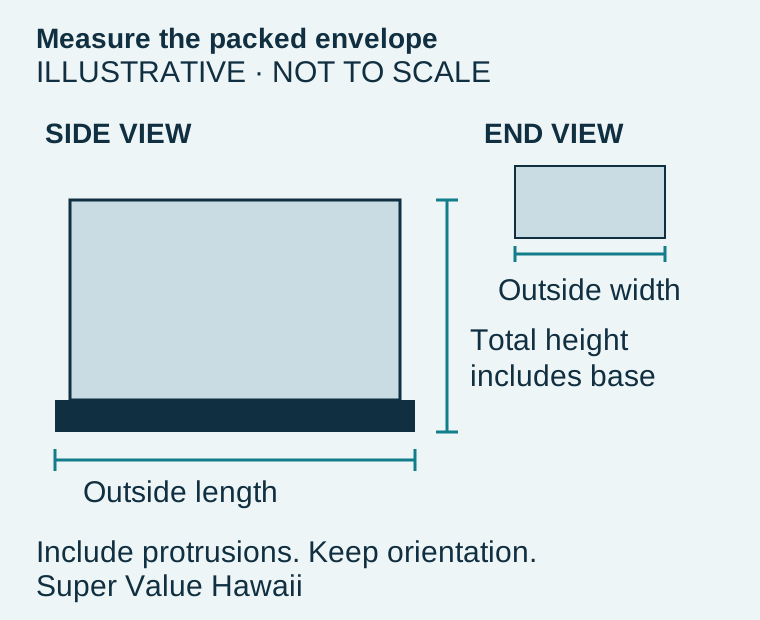
Ask for the maximum external length, width and height of each finished shipping unit. Include its crate, pallet base and any part that sticks beyond the base. Height starts at the bottom of the pallet, not at the machine’s feet. If a handle remains attached and protrudes beyond the crate, show it in the measurement and in a photograph.
Keep product dimensions in the specification sheet, and packed dimensions in the cargo list. Label preliminary figures “estimated packing” so nobody mistakes them for measurements taken after packing. Ask the supplier to send a photo showing the tape at the widest or tallest point when a dimension is unclear.
A dimension drawing also needs an orientation. State which side is the base and whether the package must stay upright. A long crate does not become shorter simply because someone rotates its dimensions in a spreadsheet.
Calculate each package size separately
CBM means cubic metres. With measurements in metres, multiply length × width × height for one package, then multiply by the number of identical packages. When the dimensions are in centimetres, divide their product by 1,000,000. Put the units in the column headings before doing any arithmetic.
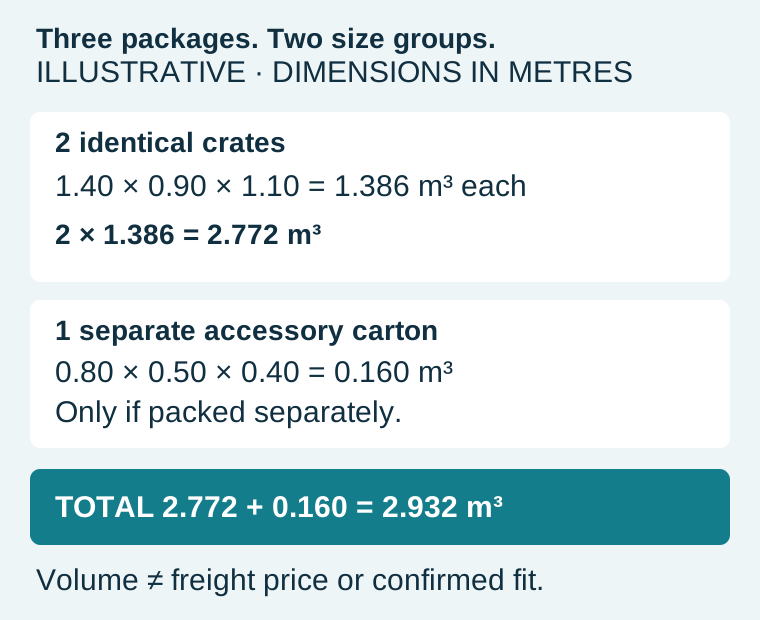
Consider this illustrative equipment order: two crates, each 140 × 90 × 110 cm, plus one accessory carton measuring 80 × 50 × 40 cm. Each crate is 1.386 m³; two total 2.772 m³. The carton adds 0.160 m³, giving 2.932 m³ altogether. These invented dimensions explain the calculation; they are not a customer record or a freight quote.
Do not average the three sets of dimensions. Do not multiply by the quantity twice if the supplier has already given a line total. Keep the unrounded figures through the calculation and ask how the quote handles measurement and rounding.
Check whether the small box is already included
Accessories are an easy source of double counting. If the accessory carton travels separately, give it its own row. If it is secured inside a crate and already included in that crate’s outside dimensions and gross weight, list its contents under the crate reference instead of adding a second transport volume.
If a carton is strapped on top, ask for the final dimensions and gross weight of that combined shipping unit. Keep a contents list that identifies both pieces. The count used for receiving should match what the receiving team will actually handle, while the contents list still explains what was purchased.
For a revised packing plan, ask the supplier to mark what changed: separate package removed, crate height increased, new gross weight. That makes it possible to compare the new list with the estimate rather than quietly replacing one attachment with another.
Why equal CBM does not mean equal container space
A short, broad package and a tall, narrow package can have the same volume but occupy different floor areas. Cargo that must remain upright limits placement further. The planner needs the individual dimensions, not only the total at the bottom of the list.
“Stackable” also needs an explanation. A flat crate lid is not evidence that it can support another load. Ask the supplier or packing provider for the permitted top load, where that load may bear, and any restrictions. If they cannot confirm those details, mark stacking as unconfirmed and send the packing information for review.
For shared container space to Hawaii, suitability depends on the other cargo, weight distribution, handling and the room needed to secure the goods. This is why a CBM total alone cannot reserve a space or prove that a load will fit. Do not remove protective packing just to reach a smaller number; any change needs the packing provider’s review.
Send gross weight per package as well as dimensions. An aggregate weight hides whether most of the load sits in one heavy crate. Supply the stated lifting points and handling instructions; the loading and unloading arrangements need their own assessment.
Freeze the packing revision before confirming transport
Use a dated packing list with stable package references. When the final figures arrive, compare them against the version used for the estimate. A changed footprint, an additional package or an unconfirmed stacking condition is a reason to request a review before collection.
Ask what the quoted amount is based on and which changes would require a revised price. Package volume is an input to that discussion, not a complete landed-cost formula. There is no single per-CBM figure in this guide because cargo handling, service scope and the destination arrangement still matter.
Include the Hawaiian island and ZIP code with the final list. A packing change can affect unloading as well as ocean transport. Super Value Hawaii assesses equipment and bulky commercial cargo for all Hawaiian islands; destination costs and handover arrangements are checked separately. Consolidation alongside our own procurement shipments depends on cargo fit, readiness and actual space.
Send this measurement request to the supplier
Ask for one dated list covering every finished shipping unit. If packing is not complete, request estimated and final figures as separate revisions.
- Package reference, contents and number of identical packages.
- Maximum outside length × width × height, with units and required orientation.
- Gross weight per package, including its packing and base.
- Photo of the finished package; show protrusions and unclear measurements.
- Stacking status and documented top-load restrictions, if any.
- Handling instructions and stated lifting points.
- Whether accessories are inside, attached to, or separate from the main crate.
- Date measured, packing-list revision and expected collection readiness.