
Equipment shipment preparation
Will your equipment crate fit through the container door?
A machine crate can be shorter than a container’s internal height and still be too tall for its door. When planning equipment shipments from China to Hawaii, ask for a door-opening check using the finished package dimensions. A CBM figure or a description such as “40-foot high cube” leaves that question unanswered.
Use the finished crate, including its base
Ask the packer for the maximum outside length, width and height after packing is complete. Include the skid or base, top framing and anything that projects beyond the main box. Keep the units, package reference and drawing revision beside the measurements. Machine dimensions from a sales brochure describe a different object.
If packing has not been completed, label the dimensions as proposed. Have the packer confirm the final measurements before dispatch. An added base or revised crate top can change a previous comparison.
Compare the crate with the container door opening
Container interior dimensions describe the space inside. Door-opening dimensions describe the entrance. Hapag-Lloyd lists these separately on its standard-container specification page and notes that its figures are examples, with variation between manufacturers. Ask the transport provider which specification applies to the proposed equipment.
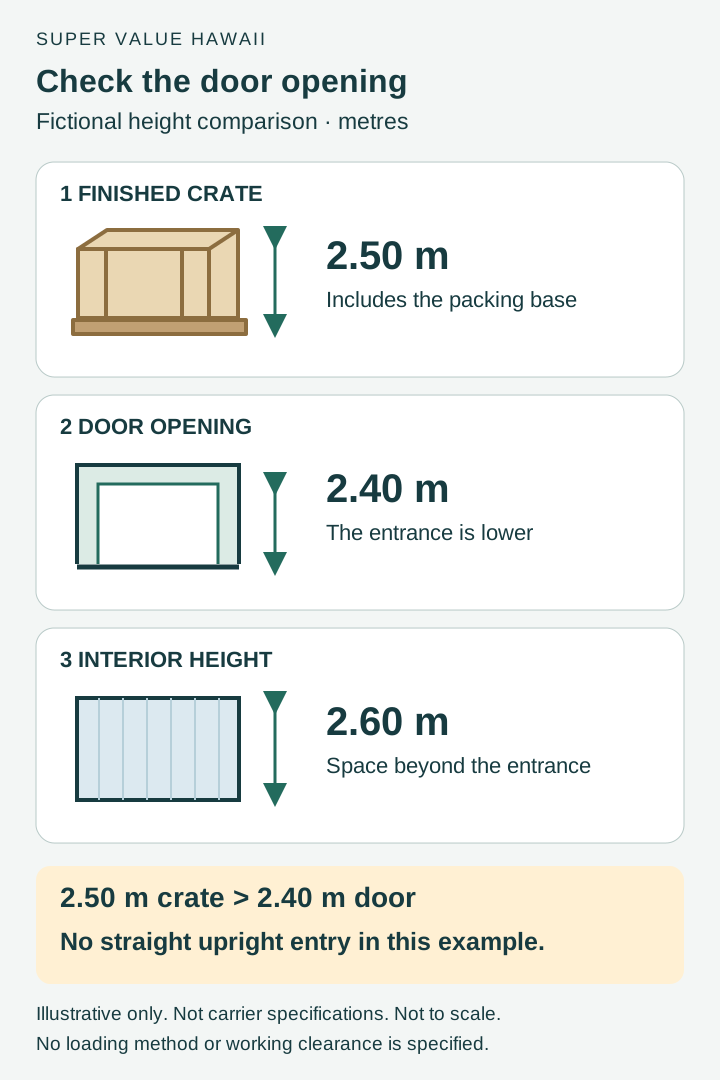
Here is a fictional height comparison: a finished crate is 2.50 m tall; the proposed door opening is 2.40 m; the interior height is 2.60 m. The crate is 0.10 m shorter than the interior, but 0.10 m taller than the opening. Those figures rule out straight upright entry in this example. They do not establish another way to load it.
Make the width comparison as well, using the stated entry orientation. A package being smaller than the opening on paper is only one input to the loading review. Equal dimensions should remain an unresolved clearance question.
Put the dimensions and the loading question in one record
Send the package drawing and measurements to the party responsible for loading. Ask for its assessment of the proposed container and entry arrangement. Keep dimensional fit separate from handling, weight and securing requirements; a doorway comparison does not approve those parts of the move.
| Review item | Question to record |
|---|---|
| Finished package | Which package and packing revision? Record maximum outside L × W × H, units, gross weight and whether each figure is final or proposed. |
| Proposed container | Which type and specification did the transport provider use? Keep the door-opening width and height separate from the interior dimensions. |
| Entry orientation | Which package dimensions face the opening in the reviewed arrangement? Identify any proposed change without assuming it is acceptable. |
| Loading review | Who assesses the entry path, handling arrangement and necessary clearance? What information or decision is still outstanding? |
| Revisions | Has the crate, base, equipment configuration or proposed container changed since review? Identify the updated records and request reassessment. |
| Dispatch decision | Which exact package and arrangement were reviewed? Keep the responsible parties’ confirmation and unresolved conditions with the shipment record. |
This is an information record, not a loading calculation or clearance allowance. The people responsible for the move must assess the actual cargo and arrangement.
Treat “we can tilt it” as a proposal that needs review
A suggested tilt, removal of a component or change of packing introduces a different arrangement. Ask the equipment manufacturer, packer and transport provider to resolve the parts relevant to them before accepting the proposal. Do not reduce the stated crate height by assuming that a base will be removed.
If a different container or transport arrangement is proposed, request a revised assessment and scope. Keep any equipment availability, route and cost questions open until confirmed. One provider’s generic container chart is insufficient evidence of an accepted shipment.
Send a focused request before arranging collection
Attach the packing drawing and final measurements rather than sending only a product link. A useful request is:
Please review package [reference and revision], with finished outside dimensions [L × W × H and units] and gross weight [value and units], against the proposed container. Identify the applicable door opening and interior dimensions, the entry arrangement assessed, and any information or conditions still outstanding. Please flag any packing or equipment change that needs a new review.
For a China-to-Hawaii shipping inquiry, send these records with the supplier location and intended Hawaii handover point. Super Value Hawaii can coordinate the cargo information and discuss shipment requirements. Consolidation depends on cargo suitability, readiness and actual space; island arrangements and costs are assessed separately. Destination access and unloading need their own check.