
Destination planning
Equipment delivery in Hawaii: plan the unload before you ship
A crated machine can reach Hawaii and still be a long way from its working position. The truck may stop at a gate. Your forklift may be somewhere else that morning. Or the quote may end at a warehouse while you were expecting delivery to the farm. For equipment delivery in Hawaii, settle the unloading plan while the machine is still with the supplier. Start with one precise question: where does the transport service end, and who moves the load from there?
Write down the handover point, not just the island
“Delivery to Hawaii” leaves too much open. Ask for the named pickup facility or delivery address, the exact handover point and the condition in which the cargo will be handed over. A crate collected at a warehouse, a crate on a truck outside your gate and a machine positioned inside your workshop each require a different plan.
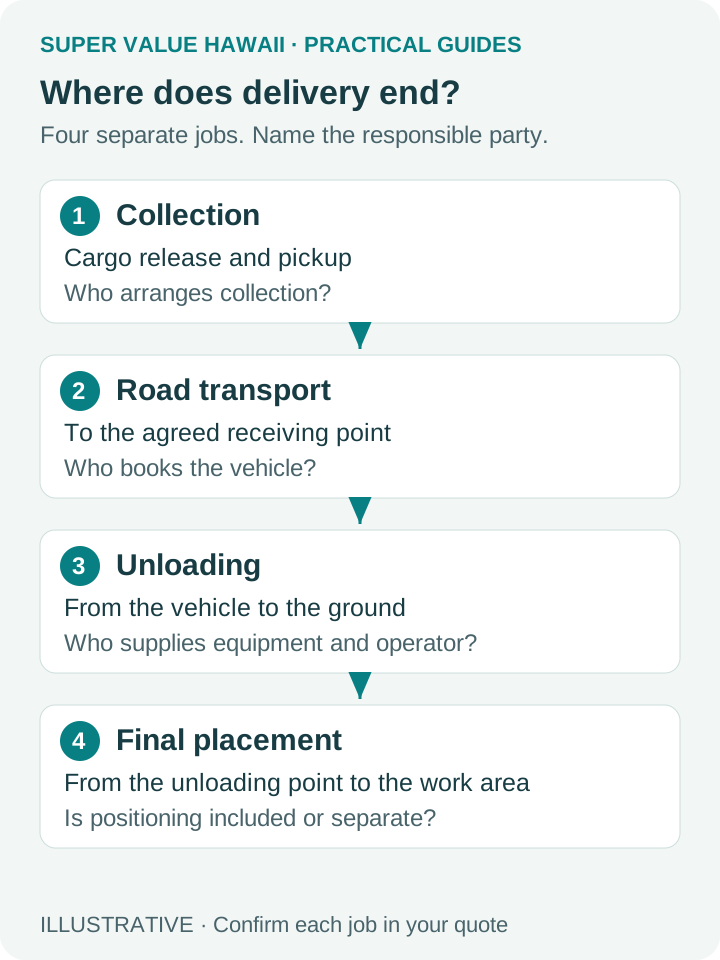
Keep four jobs separate when reviewing a quote: collection after cargo release, road transport, removal from the delivery vehicle, and movement to the final working position. Ask which are included, which you arrange, and which remain subject to assessment. If you collect the cargo yourself, confirm how it will be loaded onto your vehicle as well as unloaded at your site.
Carrier terminology is not interchangeable. For example, FedEx Freight Direct describes distinct ground-level and inside-delivery service levels in its published service information, linked below. That illustrates why a service label needs a definition; it does not establish availability, pricing or suitability for this shipment. Get your actual provider’s scope in writing.
Give the local operator a load they can assess
“We have a forklift” is useful information, but it is not a complete unloading plan. Send the operator the gross weight and outside dimensions of each shipping unit, photos of the crate or skid, and the supplier’s handling instructions. Ask the supplier to identify approved lifting points or fork pockets and any orientation restrictions. If they cannot confirm these details, mark them as unresolved rather than guessing.
The operator needs to assess the actual load, handling equipment and site together. Do not select equipment from the machine’s net weight alone or assume that a crate can be lifted from any side. A long skid or an uneven load may need a different arrangement from a compact pallet of the same weight. Have the responsible handling provider assess the method before delivery day.
A liftgate also needs assessment for the particular package and vehicle. Ask whether its usable platform, rated capacity and unloading conditions suit the packed unit. Requesting “liftgate delivery” does not, by itself, confirm that the crate can be handled or moved beyond the unloading point.
- Per package: outside length × width × height, units, gross weight and package ID.
- Clear photos of the base, fork pockets and supplier-marked lifting points.
- Supplier’s handling instructions, orientation restrictions and separately packed attachments.
- Handling provider’s confirmation of the proposed method and who supplies the equipment.
Photograph the route from the road to the receiving area
The address tells a driver where to go; it does not show whether the proposed vehicle can reach the unloading area. Send current photos of the road approach, entrance, narrowest point, turning area and intended unloading surface. Where clearance is limited, add measured widths and heights. Identify slopes, overhead obstructions, soft ground and gate or appointment restrictions.
For a farm, distinguish the public-road entrance from the equipment shed. For a business, explain whether deliveries use a loading dock, shared parking area or separate service entrance. Tell the provider where the truck can stop and where the cargo must end up, then ask them to confirm feasibility. A map pin or an ordinary car’s access is not proof that a freight vehicle will fit.
If access or unloading remains unresolved, ask whether collection at an agreed facility or transfer to a suitable local vehicle is an option. Compare the whole arrangement, including both loading and unloading. Do not book a fallback pickup until the facility and handling provider confirm it.
A farm-delivery example: find the missing job
Consider an illustrative purchase of one crated produce conveyor for a Hawaii farm. The quote names delivery to the farm address. The receiver expects the conveyor in the packing shed, but the proposed truck can reach only the roadside entrance. The supplier has supplied crate dimensions, while the local operator has not yet seen the skid or handling instructions. Two questions remain: how the crate comes off the truck, and how it travels from the entrance to the shed.
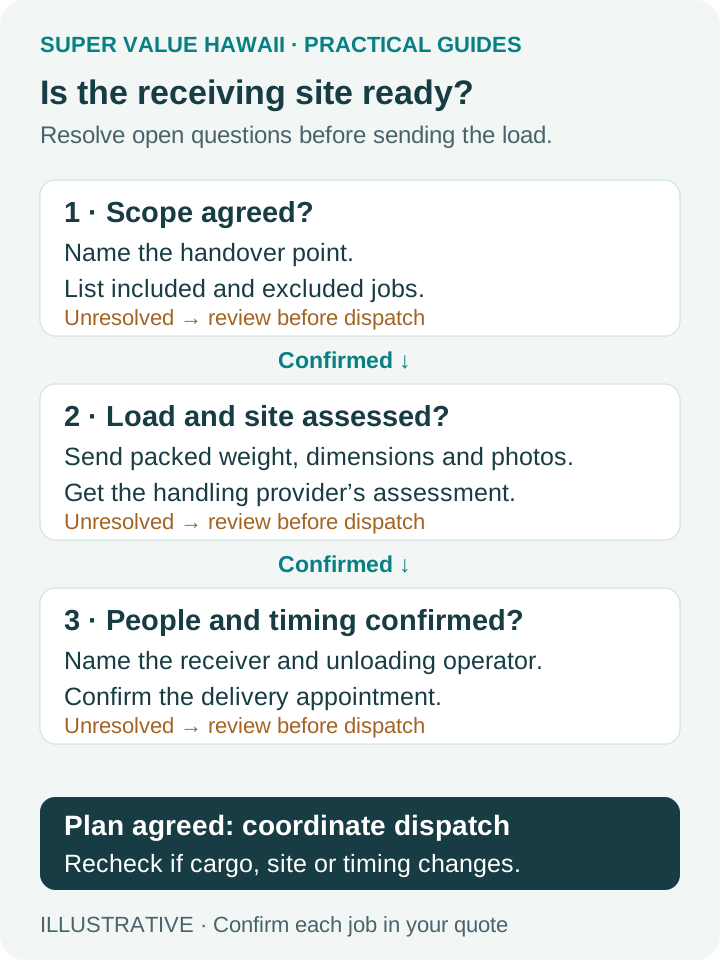
Send the packing and access information to the transport and handling providers, name the transfer point, and obtain an agreed unloading and placement scope. If a separate operator is needed, confirm who books them and how their attendance will be coordinated. The purchase may still work well; the missing scope needs resolving first.
This is a planning example, not a customer shipment. No package weight, vehicle specification, price or completion date is implied.
Agree on the appointment and the exception plan
Name the person who will be on site, their receiving hours, and who is allowed to sign for the cargo. Coordinate the unloading operator with the actual delivery appointment; a vessel arrival estimate is not an appointment at your farm. Ask who confirms that cargo is released and ready for collection, and who tells each party if that changes.
Before dispatch, clarify what happens if the site cannot receive the load: who contacts whom, where the cargo may be held, whether a new appointment is possible, and which waiting, storage or extra handling charges need review. Obtain the applicable terms from the booked providers. Do not assume a particular free-storage period or a free second delivery.
On receipt, match package IDs and counts against the documents and photograph the visible condition before unpacking. Record discrepancies with the provider promptly and follow the applicable reporting procedure. A receipt for packages is not a performance test of the machine; arrange installation and commissioning separately where needed.
- Confirmed handover point and included / excluded / unresolved services.
- Receiving contact, hours, access restrictions and appointment-confirmation process.
- Named transport provider and unloading operator, with responsibilities agreed.
- Procedure for a delayed appointment, inaccessible site or damaged / missing package.
- Suitable receiving area and a separately agreed plan for final placement and installation.
Send the destination details with your shipping inquiry
For a China-to-Hawaii equipment shipping assessment, include the product link, supplier location, packing information, island and ZIP code, and receiving-site details. Say whether you need collection at an agreed facility, delivery to a stated point, or help assessing a local unloading arrangement. Keep full addresses and contact details in the private inquiry, not a public comment.
If you want equipment to share container space to Hawaii with other compatible goods, destination handling still needs its own scope. Consolidating the ocean shipment does not establish how a particular crate will be unloaded at your site. Cargo fit, readiness and actual available space need confirmation before any shared-container arrangement is agreed.
Super Value Hawaii assesses equipment and substantial commercial cargo for customers across the Hawaiian islands. Island-specific transport, handover and handling arrangements—and their costs—are confirmed for each inquiry. Use the shipping quote link below; identify any measurement or handling instruction still pending so we can review the open question first.