
Shipment documents
Equipment for Hawaii: match the commercial invoice to the packing list
The invoice says “one machine with accessories.” The packing list names a machine, a control cabinet and a spare-parts box. Before shipping equipment from China to Hawaii, ask the supplier to show how those records connect. A commercial invoice and a packing list can describe the same shipment at different levels; you need a traceable link from each purchased item to the goods being released.
Start with the documents for the goods actually shipping
Ask the supplier for the current commercial invoice and packing list, together with the accepted order or purchase agreement. Record the issuer, document number, date and revision of each. A quotation or pro forma invoice may describe an earlier proposal; check whether the final document still reflects the accepted configuration and current shipment.
The International Trade Administration describes the commercial invoice as a document used in import and export clearance and advises checking destination-specific requirements. Its packing-list guidance focuses on the contents, weights and measurements of individual packages. Use these sources to understand the documents’ roles; confirm the actual shipment paperwork with the parties preparing the entry.
Compare the seller, buyer and intended receiving details across the records. If a trading company issues the invoice while a factory packs the equipment, ask the coordinator to explain that relationship and retain the relevant order references. Different names need an explanation before someone copies them into another document.
Give each invoice line a route to the packed goods
For each invoice line, record the equipment name, manufacturer and model, quantity and unit, and the corresponding packing-list item or package marks. Use a serial number or other unit reference where it is available and relevant. “Machinery” is difficult to reconcile against a named machine and several separate components.
An invoice line can cover several packages, and one package can contain items from several invoice lines. Ask for a cross-reference that explains those relationships. Count purchased units and outer packages separately, then check that every item intended for this shipment appears somewhere in the contents record.
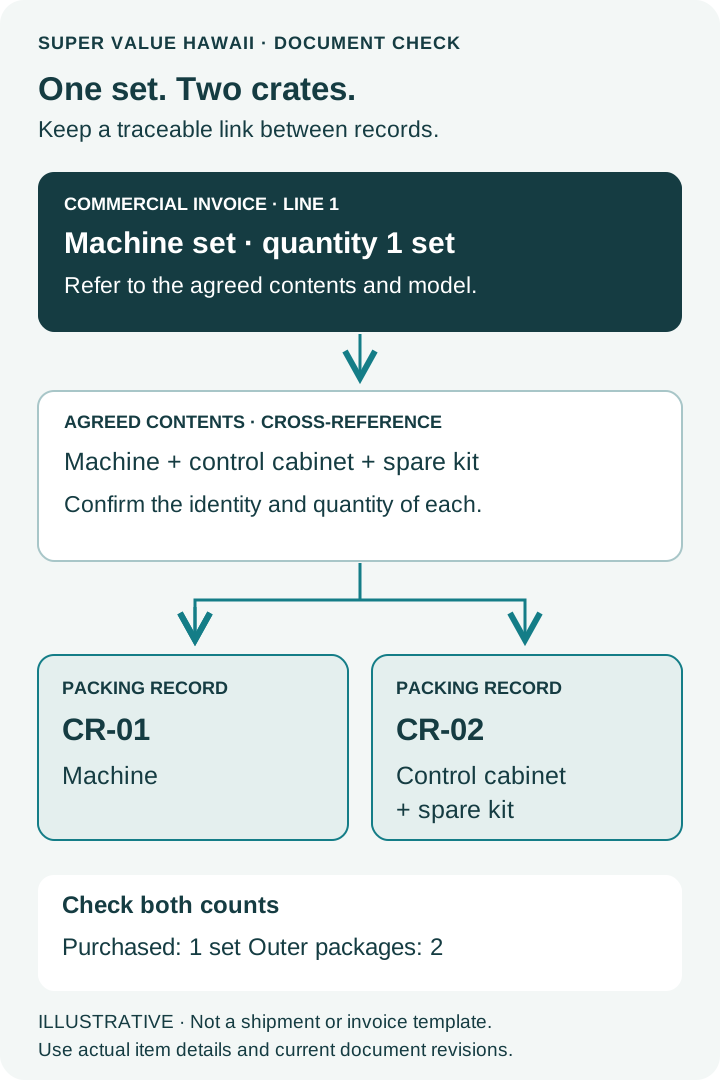
In the illustrative example below, invoice line 1 covers one machine set. The approved set includes the machine, its control cabinet and one spare kit. The packing record places the machine in CR-01 and the cabinet and kit in CR-02. The invoice quantity can remain one set while the outer count is two crates, provided the set’s contents are clearly documented. This is a reconciliation example, not an invoice template or a customer shipment.
Resolve accessories and partial shipments explicitly
Check every attachment, spare, tool and installation item against the accepted scope. “Included” tells you about the purchase agreement but leaves the packing location unanswered. Ask the supplier to identify the item, quantity and package reference. If its price is bundled with the machine, retain that explanation for the party reviewing the invoice.
If an item is supplied without a separate charge, tell the document preparer how it was supplied and ask how it should be represented. Do not invent a value, omit the item, or assume a no-charge item needs no documentation. The appropriate treatment depends on the actual transaction and shipment.
For a split order, mark what ships now and what remains with the supplier. Keep the current shipment quantity separate from the full order quantity and the quantity already shipped. An earlier invoice covering the entire order may need clarification or revision; ask the issuer and shipment coordinator which document set should accompany this release.
- Included and packed: the agreed item is listed and has a package reference.
- Included but outstanding: the item remains due; record where it is and the agreed next action.
- Removed or substituted: retain the buyer’s agreement and update affected descriptions and values.
- Shipped separately: identify the separate shipment reference when known; do not count it in this release.
- No separate charge: preserve the commercial explanation and obtain document-preparation advice.
Check the arithmetic without guessing the declared value
Read the currency and quantity unit on every commercial line. Recalculate quantity multiplied by unit price, then reconcile the line totals, stated discounts, separate charges and final total. Check what the total covers against the agreed transaction terms. A payment receipt is useful supporting evidence, but the amount paid so far may be a deposit or a balance rather than the total value of this shipment.
For a simple illustrative arithmetic check, two identical attachments at USD 450 each produce a line total of USD 900. If the invoice shows USD 450 as the line total, ask the issuer whether the quantity, unit price or total is wrong. Resolve the underlying transaction and obtain a corrected document; changing a number merely to make the columns agree can conceal the error.
Keep transport, packing and other quoted charges identifiable under the actual agreement. Refer questions about customs value, classification or required supporting documents to the responsible customs professional. This arithmetic check does not determine those answers or establish a tax-inclusive landed cost.
Keep each supplier’s records attached through consolidation
When combining orders from multiple suppliers, use a supplier-and-order prefix in your working cross-reference. Two suppliers can both have an invoice numbered 001 and a crate marked 1. Preserve each issuer’s original references, then add a coordinator’s reference that makes the combined register unambiguous.
Keep each source invoice and packing list available with the consolidated register. A summary used to plan shared container space to Hawaii should preserve the link back to the source records. Ask the document preparer how the transaction parties and shipment should be represented; do not merge sellers or invoice values by copying one supplier’s header over another.
If repacking changes a package mark, carry the old-to-new reference into the register and obtain updated packing data. A packaging change alone does not explain a change to the model, quantity or purchase price. Investigate each difference on its own. Consolidation still depends on cargo suitability, readiness and actual space.
Close discrepancies with a revised document and a named owner
Write a short exception list: the conflicting field, the two source references, the question to resolve and the person responsible. For example: “Invoice line 2 names model A; the packing list names model B. Supplier to confirm the actual unit and send the corrected document with a matching nameplate photo.” Keep the issue open until that evidence arrives.
Have the issuer correct its document. Retain superseded revisions with a clear status and send the current set to the coordinator and other relevant parties. Ask them to confirm which revision they will use before relying on it for collection or paperwork.
For a shipment assessment, Super Value Hawaii needs the actual equipment identity and photographs as well as final packing details, supplier location, purchase information and the proposed Hawaii receiving point. Identify unresolved document questions when you send the request. Destination arrangements for each island and their fees require a separate review.
Please cross-reference each commercial invoice line to the packing-list items and outer package marks for this shipment. Confirm the exact equipment models, quantities and units, included accessories and any items shipping later. Please check the currency, unit prices, line totals and separately stated charges against our agreement. Explain any differences and issue corrected documents with a clear revision reference.