
Equipment procurement
A spare-parts list to request before shipping equipment from China to Hawaii
Your equipment quotation includes “one set of spare parts.” Ask what is in that set before accepting the order. For a machine bought in China and shipped to Hawaii, you need a list that identifies each part, explains why it is supplied and shows where it will be packed. That record also gives you something usable when ordering a replacement later.
Start with the machine that will actually ship
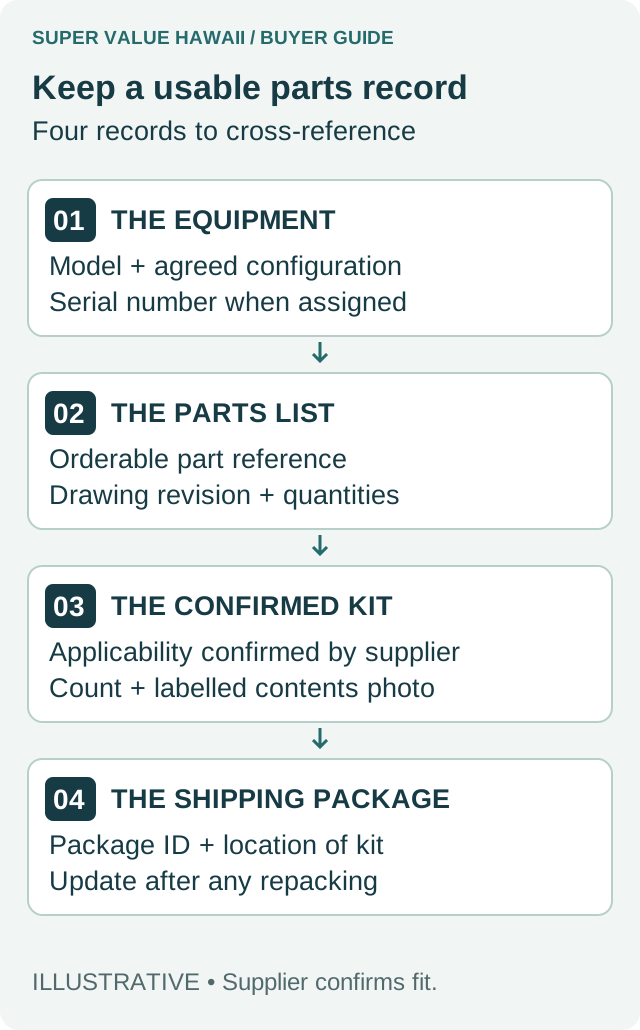
Put the supplier, model, purchase-order reference and agreed configuration revision at the top of the parts list. Add the serial number when the finished unit has one, and request a readable nameplate photograph. If an engine, pump or attachment has its own identification, ask the supplier which identifiers are needed for its replacement parts.
Caterpillar’s own parts guidance describes searching by machine serial number and using parts diagrams. It illustrates a useful identification method; its catalog does not establish compatibility for equipment from another manufacturer. Have your equipment supplier confirm the references for the unit you are buying.
If the supplier changes a component during production, ask whether the parts list changes with it. Record the substitution and the current reference before accepting the revised kit. A list prepared for the quotation can become outdated even while the machine’s sales model stays the same.
Separate installation items, consumables and operating spares
Ask the manufacturer to group its proposed kit by purpose. An item required to assemble or commission the machine should be identified separately from a replacement kept for later use. Otherwise an installation component can be counted as a spare and used up before work starts.
For consumables and scheduled-maintenance items, request the applicable manual reference, service interval or replacement criterion. For wear parts and other operating spares, ask why each item is recommended for your intended work. Let the manufacturer and the person responsible for maintenance advise on quantities; a standard kit may not suit your usage or support arrangements.
- Installation or commissioning: what is required to make the delivered configuration ready for its agreed use?
- Consumables or scheduled maintenance: which items are specified by the applicable manual, and when are they used?
- Wear parts: which replaceable items are relevant to the work and conditions you described?
- Other proposed replacements: why stock each item, and who can diagnose and install it?
Keep warranty coverage separate from this purchase list. Confirm whether an item is included with the machine, an extra paid item or only available to order later. A support promise does not confirm that a replacement is physically in the shipment.
Make each line specific enough to order again
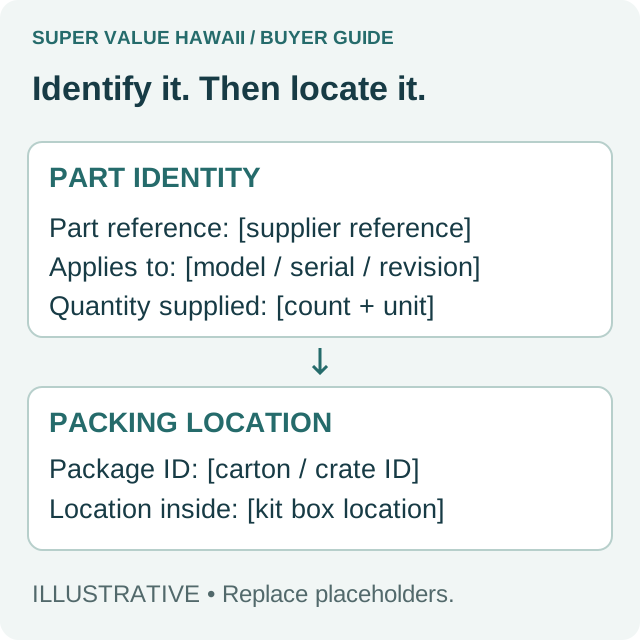
A drawing callout such as “item 12” usually points to a location in a particular drawing. Ask for the supplier’s orderable part reference as well as the drawing title, revision and callout. If the manufacturer has no catalog number, obtain a written reference that its parts team can use to identify and quote the item.
Keep the description in English and retain the supplier’s original description beside it where useful. Request a labelled photograph or drawing for items that are difficult to distinguish. A photograph helps identify what was supplied, but appearance alone cannot confirm fit or performance.
- Machine model, configuration revision and serial number, when assigned.
- Part description and manufacturer or supplier part reference.
- Drawing or manual reference, revision and item callout, if available.
- Quantity supplied, its unit, and the quantity required per machine or assembly as separate fields.
- Purpose of the item and whether it is included, separately priced or deferred.
- Any serial-number range, component variant or other applicability restriction confirmed by the supplier.
- Package identifier and location inside that package, completed when packing is final.
Use the kit list to check the packed shipment
Before the box is closed, ask for a count against the agreed list and a photograph showing the labelled contents. Cross-reference the kit to a shipping package identifier. If it is packed inside the main machine crate, record that location; if it ships as a separate carton, give the carton its own cargo-list entry.
For a separate package, collect its final outside dimensions, gross weight and handling details. If several suppliers provide equipment and accessories, retain the supplier and order references through consolidation. Ask for an updated package map if receiving or repacking changes a box identifier.
Ask the supplier to flag batteries, liquids, chemicals or other items needing separate transport review before adding them to the kit. Listing an item as a spare does not determine whether it can travel under the proposed arrangement.
Resolve a changed part before approving the kit
Consider an illustrative purchase: the drawing shows one pump variant, while the finished machine’s component plate identifies another. The supplier’s kit list still refers to the first variant. Keep the drawing, plate photograph and list together, and ask the supplier to confirm which references apply to the finished unit.
Obtain a corrected list with a date or revision and a clear explanation of any superseded part. Ask whether the change affects installation items or maintenance instructions too. Have the person responsible for the equipment review unresolved technical questions. Do not approve a substitute solely because its dimensions or photograph look similar.
Copy this request to your equipment supplier
Replace the brackets with your order information and send this while the equipment configuration is being agreed:
Please provide an itemized spare-parts and accessory list for [purchase order/model], configuration revision [reference]. Add the machine serial number and nameplate photo when available. For each item, show the description, supplier or manufacturer part reference, drawing/manual reference and revision if available, purpose, quantity supplied and unit. Show the quantity required per machine separately. Identify installation items, consumables, wear parts and other recommended spares, and explain the basis for recommended quantities. Confirm applicability to the actual unit, any proposed substitutions, and which items are included or separately priced. Before shipment, provide the checked quantities, labelled contents photos and shipping package identifiers or locations. Flag items needing separate transport review. Please identify a parts contact and explain what information we should provide for a future replacement order.
Save the confirmed list, applicable manuals and nameplate photos with the equipment purchase record. Keep a copy accessible to the person receiving and maintaining the machine in Hawaii.
Include the kit when planning the Hawaii shipment
For an equipment sourcing and shipping inquiry, send the agreed machine specification, proposed kit list, supplier-ready dates and destination island and ZIP code. Identify separate cartons and any unresolved items. This lets us review equipment and accessory coordination together.
Combining the kit with the equipment shipment depends on readiness, cargo suitability and actual container space. Changes after packing may require a revised cargo assessment. Hawaii’s islands can be considered, with island-specific arrangements and fees reviewed separately.