
Equipment sourcing & after-sales planning
Buying equipment from China for Hawaii: warranty and repairs
An equipment quote says “one-year warranty.” Before buying from China for your Hawaii farm or business, ask what happens if the machine stops after arrival. Who diagnoses the fault? Who fits the replacement? Who pays to get it to your island? A useful repair plan answers each question beside the warranty period.
Ask who provides support at your destination
Send the supplier the machine model, intended use and destination island. Ask whether its offer includes remote technical help, an onsite visit, a replacement component or a return to a repair facility. Record the named provider for each offered service. A sales contact who forwards messages to the factory is a different arrangement from a technician who can work on the machine locally.
For a concrete example of why the distinction matters, Grizzly’s published repair guidance describes support by phone or email and repairs at its facilities; it says it does not provide onsite repairs. It also requires repair authorization. Those are Grizzly’s arrangements, not the terms of your Chinese supplier and not evidence of a service relationship with Super Value Hawaii.
Ask a proposed local technician whether they can support the exact model and configuration. Share the manual and parts drawings before relying on that option. Record any limits, such as diagnosis only, mechanical work only or work requiring a different specialist.
- Provider: which company accepts the support request, and which company performs the work?
- Destination: does the written offer cover this island and receiving location?
- Access: what manuals, drawings or software are needed, and will you receive them?
- Availability: what contact channel, working hours and escalation route are actually offered?
Put the warranty clock and coverage in writing
Ask for the supplier’s warranty document tied to your quotation and configuration. Record the event that starts the period: for example, invoice, dispatch, delivery or commissioning, if that is what the supplier offers. “One year” without a start event leaves you unable to work out how much time remains when the machine arrives.
List the covered components, exclusions and required maintenance records. Ask how third-party components are handled and whether the seller or the component maker manages the claim. Keep the manual revision, purchase reference and later serial number with the same record.
Clarify approval requirements before arranging local repairs, fitting substitutes or returning anything. Ask the supplier to confirm how each proposed action would affect its coverage. These are questions for the actual provider; a general checklist cannot decide a claim or establish what a particular warranty covers.
Separate a replacement part from the cost of the repair
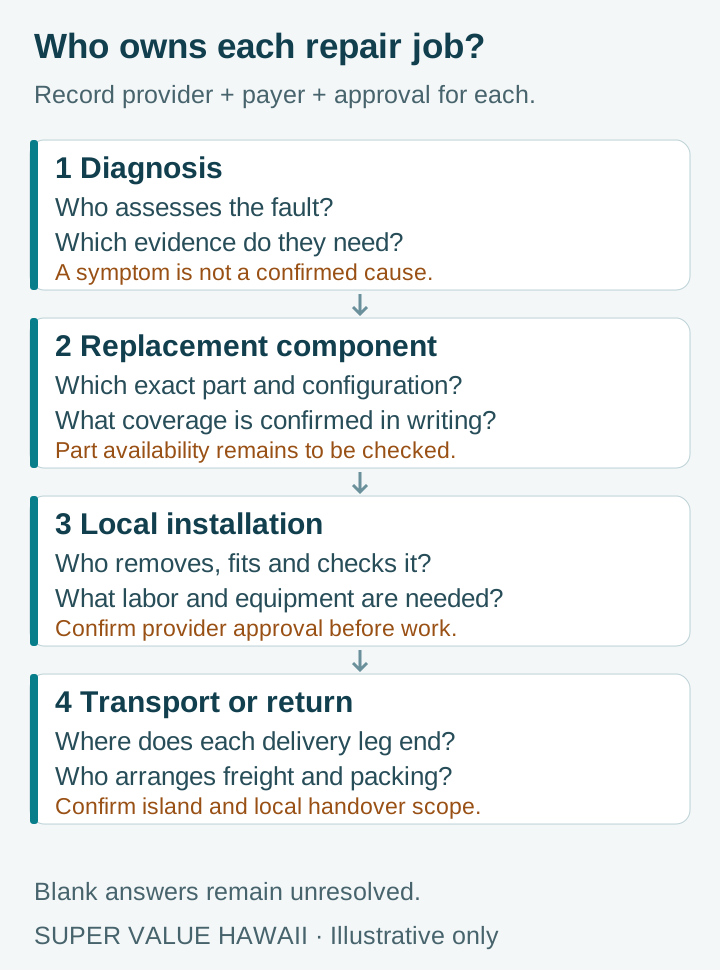
A supplier may agree to provide a component while other jobs still need an owner. Make separate entries for diagnosis, the part, removal and installation, tools or lifting, packing, outward freight and any return freight. Beside every entry, write the provider, who approves it and who pays. Mark an unanswered item “unresolved.”
Illustrative scenario: the supplier approves a replacement control module at no charge, but its message says nothing about installation or delivery. Before accepting the remedy, clarify the part number and configuration, who will fit it, where the supplier will hand it over, and who arranges each transport leg. The example assumes no actual fault, price or supplier commitment.
For a Hawaii destination, ask whether the transport offer ends at a carrier handover, port, local pickup point or your site. Confirm island transfer, local delivery and unloading where relevant. A return to a factory needs its own packing, handling and transport review; the original outbound shipment quote does not establish the return scope.
Agree what happens after the first support request
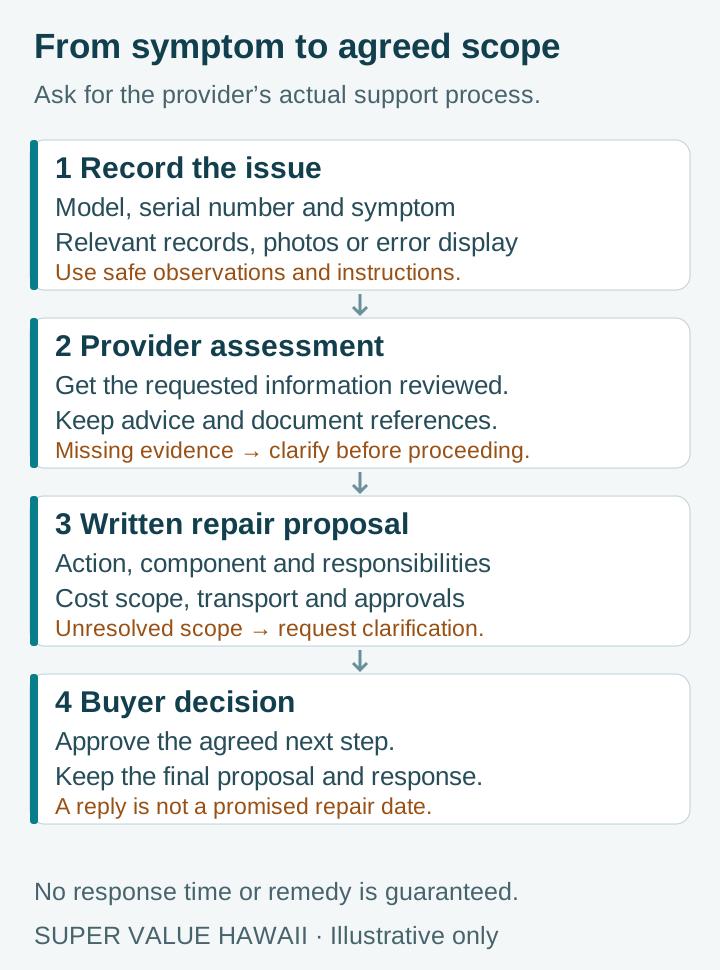
Ask the supplier for its information requirements and approval steps before dispatch. A practical request record identifies the model and serial number, describes the symptom, states when it occurred and links the relevant photos or error display. Keep the original description and the provider’s replies together so later advice can be traced.
Follow the machine’s instructions and use an appropriate technician for technical work. Record a visible symptom without treating it as a diagnosis. A support video should not require operating damaged equipment or exposing energized parts merely to reproduce a fault.
Ask for separate expectations for an initial reply, diagnosis, parts availability and dispatch. A quick acknowledgment does not establish a repair date. If the proposed remedy changes, request an updated written scope and costs before agreeing to the next step.
Use one support record when comparing suppliers
Compare the same support questions alongside the machine specification and purchase price. Keep explicit exclusions visible. An unanswered installation or freight question is a decision still to make, even if the equipment price and warranty duration match.
The blank support record below has space for the provider’s answer, responsibility, document reference and open question. Complete it with the supplier before ordering; add the serial number when allocated. Keep private order details in your own records.
When discussing sourcing and shipping with Super Value Hawaii, include the agreed machine configuration, destination island and any accessories or spare parts you plan to ship. Supplier warranty coverage and any local repair arrangement need their own written confirmation. Including a spare-parts kit or replacement in a consolidated shipment remains subject to cargo suitability, readiness and actual available space.
Please send the support terms for this quoted configuration and our destination island. Confirm the warranty start event, covered items, support provider and approval steps. Separately identify responsibility for diagnosis, local labor, replacement-part delivery and any return. List unanswered items rather than assuming they are included.