
Purchasing terms & supplier coordination
EXW vs FOB for China-to-Hawaii equipment: name the handover
One supplier quotes an equipment order EXW; another writes “FOB China.” Before comparing those offers for a Hawaii shipment, locate the handover in China. A factory pickup, a carrier handover and delivery aboard a vessel are different jobs. Your price comparison needs the same equipment specification and a clearly identified delivery point.
Write a place and point beside the three letters
Incoterms® are trade rules published by the International Chamber of Commerce (ICC). They allocate specified delivery, cost and risk responsibilities between buyer and seller. The International Trade Administration lists EXW and FCA with a named delivery place, and FOB with a named loading port. Add the rule version and a precise point to the supplier’s offer.
“FOB China” leaves the port unidentified. “EXW factory” leaves you looking for the actual factory and pickup point. Ask the supplier to identify the location, site contact and agreed handover event. Put the resulting answer in the purchase documents and collection instructions so the transport provider can assess the same job.
Keep the named point in your private order record; there is no need to publish a supplier’s address or contact details. If the supplier changes the point, ask for a revised offer and collection scope before dispatch.
- Rule: EXW, FCA or FOB, with the agreed Incoterms version.
- Location: named place or loading port, plus the relevant precise point.
- Event: what must have happened for delivery under that arrangement?
- Evidence: which document or receipt will record the agreed event?
Match EXW, FCA or FOB to the actual handover
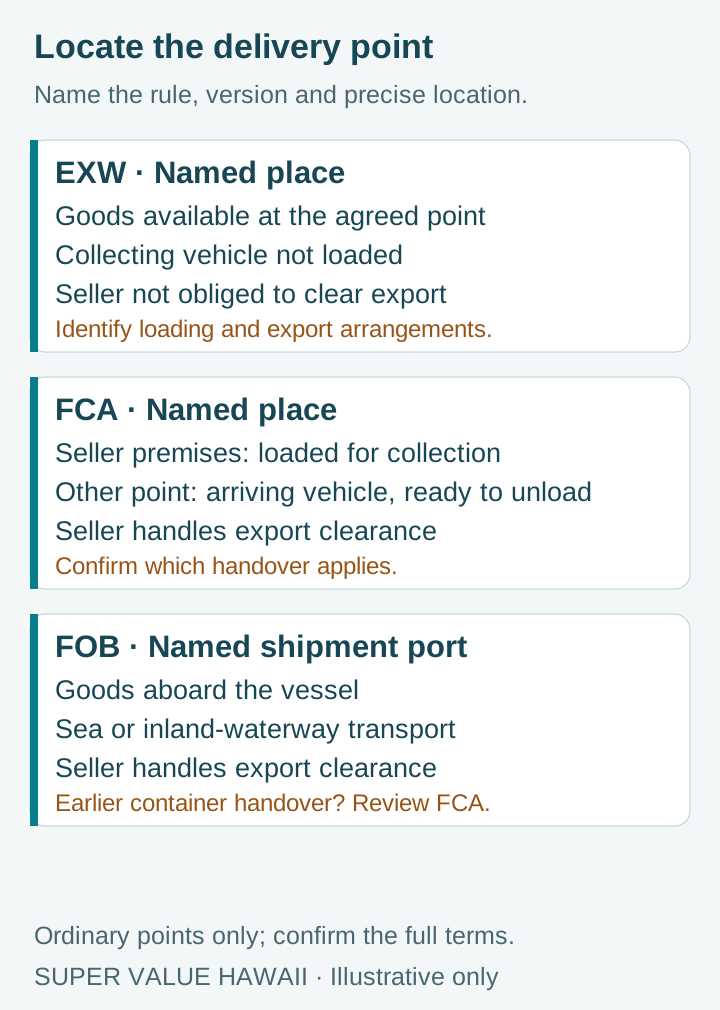
Under EXW (Ex Works), the ordinary delivery point is goods made available at the named place. ICC’s explanation states that the seller does not have to load the collecting vehicle or clear the goods for export. For a proposed EXW pickup, identify who will perform those jobs and how loading responsibility will be agreed.
FCA (Free Carrier) uses delivery to the buyer-nominated carrier or person. At the seller’s premises, delivery includes loading the collecting vehicle. At another agreed location, it is on the arriving vehicle ready for unloading. The seller handles export clearance. Ask which of these arrangements the supplier is offering.
FOB (Free on Board) uses delivery aboard the vessel at the named shipment port and applies to sea or inland-waterway transport. For container cargo handed over before vessel loading, ICC’s published guidance points to FCA for consideration. Ask the supplier and transport provider whether the chosen rule fits the real collection and container handover.
The illustration shows these ordinary delivery points. It is a discussion aid for identifying work, not a complete reproduction of the rules or a decision about a particular loss. Read the agreed rule and any specific terms together when confirming the transaction.
Compare offers at one endpoint
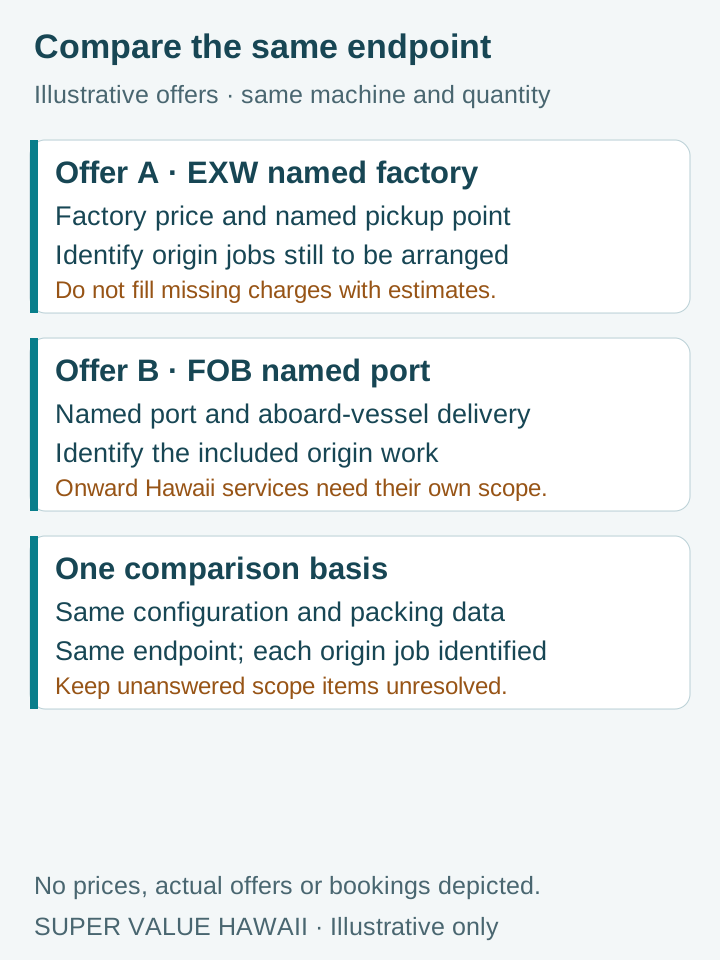
Illustrative comparison: supplier A quotes EXW at its named factory; supplier B quotes FOB at its named port. Both offer the same machine configuration and quantity. The product totals alone leave the origin work on different bases. Ask for the relevant factory loading, pickup, export and port work to be identified before judging which proposal suits your plan.
Choose a comparison endpoint that your transport provider can assess. Request a written breakdown showing who performs each job, whether its cost is included or separately quoted, and any unresolved condition. Use the same packed dimensions, weight, handling requirements and cargo-ready information for both offers.
Keep unavailable costs blank and label them unresolved. A factory price plus an unknown collection job cannot be turned into a dependable port total by inserting a guessed charge. Equally, a FOB offer does not by itself quote the onward sea shipment or the receiving work in Hawaii.
Give each supplier its own delivery record
When combining orders from multiple suppliers, record each seller’s delivery point separately. A shared receiving warehouse does not automatically change the sale terms of every order. Clarify who arranges the move from each seller, who confirms warehouse receipt, and what onward shipment services have been agreed.
Keep the supplier’s delivery event separate from the warehouse’s operational checks. A warehouse receipt may record arrival and package count; confirm whether it is also the evidence agreed for the seller’s delivery obligation. Do not treat it as a product-quality acceptance or proof of departure aboard a vessel.
Use the downloadable review sheet to link the purchase reference, rule, location, loading and export roles, transport handover evidence and open questions. It remains a working record until the parties answer the outstanding items. Consolidation also depends on cargo fit, readiness and actual space.
Keep the Hawaii destination and purchase details explicit
The International Trade Administration explains that Incoterms do not settle payment timing or ownership transfer. Record those matters in the purchase agreement, together with the equipment specification, quantity and other agreed conditions. The three-letter term cannot replace that information.
For shipment planning, state the destination island and receiving point separately from the origin delivery term. Identify the requested scope for sea transport, destination handling, island transfer and unloading. All Hawaiian islands can be assessed; costs and handover arrangements need confirmation for the cargo and location.
Send Super Value Hawaii the supplier offers, the named origin points, final packing information and your intended destination. We can review the sourcing and shipment coordination scope. Resolve any inconsistent term or missing responsibility with the relevant parties before authorizing collection.
Please confirm the delivery rule, Incoterms version, named place or port and precise handover point for this offer. Identify who handles loading, collection, export clearance and the agreed delivery evidence. Show included and separate origin jobs, and list unresolved items. We need the same equipment and delivery basis before comparing offers.