
Equipment purchasing
Compressed air for China equipment: a Hawaii buyer’s data sheet
An equipment quote lists “air supply: 0.6 MPa.” You already have a compressor at your Hawaii workshop. Can it run the new machine? That pressure figure leaves the air quantity and operating pattern unanswered. Before ordering equipment from China, ask the supplier for a compressed-air requirements sheet that the person assessing your site can compare with the available supply.
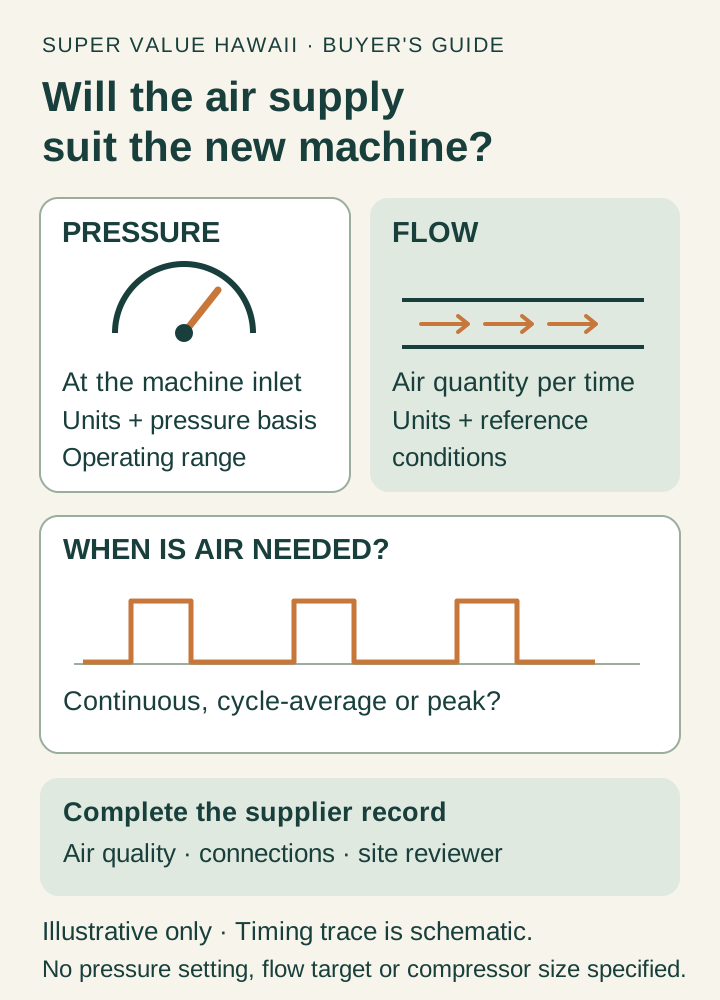
Ask what the pressure figure describes
Kaeser’s air-requirements guide calls for pressure at the point of use. Have the supplier identify the required operating pressure at the machine inlet, the permitted range and the units. Ask whether the figure uses gauge or absolute pressure. Keep any maximum permitted pressure in a separately labelled field so that it cannot be mistaken for the normal supply requirement.
Request the source page or drawing for the exact machine configuration. A short sales-table entry may omit the location or conditions of the stated requirement. Leave those fields open until the supplier answers them.
Get the flow figure and its reference conditions
Atlas Copco’s sizing guide treats pressure and flow as separate inputs. Its measurement guide explains that a volumetric flow statement needs its conditions, because air volume changes with pressure and temperature. Free air delivery, or FAD, expresses delivered air as an equivalent volume at stated inlet conditions.
Copy the supplier’s full flow notation into the sheet: for example, L/min, Nm³/h or SCFM, together with the definition and reference conditions it uses. Ask which operating pressure the machine’s consumption applies to. Have the technical reviewer resolve differing bases before comparing machine demand with compressor delivery.
In the fictional quote above, the next useful action is to obtain the missing flow and conditions. Converting 0.6 MPa into another pressure unit would still leave those fields unanswered. No compressor size can be selected from this example.
Describe when the machine uses air
Ask whether the flow is a continuous requirement, an average over a stated cycle, or a short peak. For cycle-based figures, record the cycle definition and proposed rate. Ask which functions can operate together and whether optional equipment changes the requirement.
Give the site reviewer the intended work pattern and details of other equipment using the same supply. Atlas Copco identifies frequency and simultaneous tasks as factors in flow demand. A factory demonstration’s air supply also needs to be identified before it can inform the Hawaii site review.
Send one sheet with traceable answers
Use the rows below for a supplier response. Keep each answer beside its document reference and revision. Mark a missing answer “pending”; a blank field can otherwise look as though no requirement exists.
| Review item | Question to record |
|---|---|
| Machine and source | Which model, configuration and offer revision? Identify the manual or drawing page supporting each requirement. |
| Inlet pressure | What operating pressure and permitted range apply at the inlet? Give units and gauge/absolute basis; label maximum pressure separately. |
| Air flow | What quantity, units and reference conditions apply? Identify the consumption basis and associated operating pressure. |
| Demand pattern | Is the figure continuous, cycle-average or peak? State the cycle, intended rate and simultaneous machine functions. |
| Quality and connection | What air-quality, moisture and oil requirements does the manufacturer specify? Provide inlet connection details and the included treatment equipment. |
| Site review and scope | Who will compare these requirements with the Hawaii supply? Record open items and who supplies any separately required equipment or installation work. |
This is a purchasing information sheet. Equipment selection and installation remain subject to the machine manufacturer’s requirements and a competent site assessment.
Check what the equipment offer includes
Kaeser notes that the required air quality determines the filtration and drying system. Obtain the machine manufacturer’s actual quality requirements, including any stated moisture and oil limits, before comparing the supply arrangement. Avoid filling this field with a general description such as “clean air.”
Ask the supplier to list any compressor, dryer, filter, receiver, regulator or connection kit included in the offer. Request the specifications for included items and identify everything the buyer must arrange separately. Have the person assessing the site confirm the required arrangement before treating it as compatible.
If the purchasing scope changes, obtain a revised item list, packing details and quote. Additional equipment can change the shipment to be assessed. Supplier consolidation and shared container space to Hawaii depend on cargo suitability, readiness and actual available space; the utility review does not reserve a shipment.
A short request for the equipment supplier
Attach the offer revision and send a request that gives the supplier a clear set of fields to complete.
For the machine in offer [reference/revision], please provide the compressed-air requirements at the machine inlet: operating pressure and range, flow with units and reference conditions, and continuous/average/peak demand with its cycle definition. Please include air-quality requirements, inlet connection details, the source document pages and a list of air-supply items included or excluded from your offer.
Super Value Hawaii can discuss procurement coordination and shipping once you have the machine offer and the questions still open. Send those details through the inquiry below. The Hawaii utility assessment, destination arrangements and related costs need confirmation for your particular order.