
Equipment purchasing
Equipment shipped disassembled to Hawaii: agree the reassembly scope
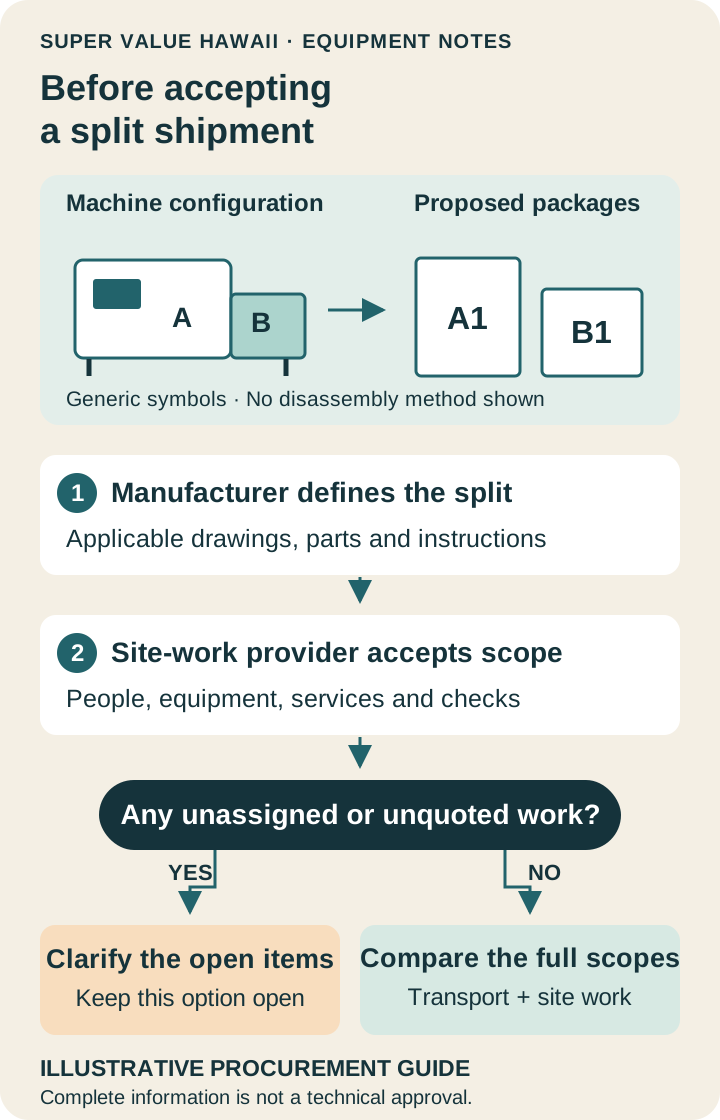
If a supplier proposes removing a conveyor or another section to reduce a machine’s shipping size, ask what must happen after arrival in Hawaii. Before accepting equipment shipped disassembled, agree who will reassemble it, what that work includes and how completion will be checked.
Get a shipping configuration for the exact order
Ask the manufacturer to identify every section it proposes to remove. Request a marked drawing of the assembled machine and a second view showing how the components will be packed. Tie both to the model, selected options and drawing revision. “Partly disassembled” leaves too much open.
Confirm that the proposed split is an arrangement the manufacturer permits for this machine. A seller’s suggestion to remove a part needs that confirmation before anyone plans the work. Grizzly, for example, publishes a policy against pre-shipment component modifications to its factory-packaged machines, with a stated exception. That policy illustrates why the actual manufacturer’s answer matters; it does not establish your supplier’s terms.
Give reassembly its own written scope
Douglas Machine’s installation page includes reassembly and service connections among installation tasks. It separately identifies buyer responsibilities such as rigging, utilities and personnel. This is one manufacturer’s allocation, not a quote for your order or evidence of service availability in Hawaii.
Ask which jobs your proposed arrangement includes: unpacking and positioning, mechanical reassembly, service connections, required adjustments, and commissioning. Commissioning is the agreed setup and functional checking needed to bring the assembled machine into service. Record who performs each applicable job and who supplies the necessary equipment.
A transport offer that names a delivery point still needs an answer about these site tasks. Have the supplier and proposed installer state the included work, exclusions and completion evidence. Avoid leaving the whole list under a single line called “installation.”
Have the proposed installer review the split before you accept it
Send the installer the applicable drawings, assembly instructions, component list and proposed shipping configuration. Ask whether they can undertake the specific work at your location. Obtain their questions while the supplier can still revise the proposal.
Clarify whether the manufacturer requires its own technician or supervision for any part of the work. If remote support is proposed, identify the onsite person who will carry out the tasks, confirm that they accept the work and list the information they need.
Where a visit is needed, request the quoted travel, labour and equipment scope and the conditions for scheduling it. Keep arrangements provisional until the provider confirms them. Do not treat the expected delivery date as an installation appointment.
Keep one record of the work still to be assigned
The blank worksheet records the answers for one shipping proposal. Use the same references in the supplier’s offer and installer’s scope. An empty responsibility or price field remains an open item.
| Review item | Question to record |
|---|---|
| Shipping configuration | Which machine, options and drawing revision define the proposed split? Has the manufacturer confirmed it? |
| Removed items | Which components, fasteners and connection parts are supplied, and in which identified packages? |
| Instructions | Which assembly documents apply? What manufacturer attendance or supervision is required? |
| Site work | Who accepts each applicable task, and who supplies labour, equipment and prepared services? |
| Quoted scope | Which transport and site-work costs are included, excluded or still unquoted? |
| Completion evidence | Which checks, results and unresolved items will the responsible parties record after reassembly? |
This is a purchasing record. The manufacturer and responsible technical providers determine the procedures, qualifications and checks for the actual machine.
Compare two complete scopes
Consider a fictional comparison: option A keeps the machine assembled; option B removes a section and uses two packages. The supplier has described the freight arrangement for B but has not obtained a reassembly quote. B is still an incomplete option, even if its packed volume is lower.
Compare the applicable packing, transport, site labour, equipment, service connections, travel and checks for both options. Use amounts from actual offers and show missing prices explicitly. A smaller crate alone cannot establish which arrangement has the lower total cost.
Also ask what must be checked again after reassembly. Keep the factory test record, but have the manufacturer and site reviewer define the checks required for the delivered configuration. A factory demonstration does not document the result of work that has yet to happen in Hawaii.
Keep the agreed split with the final packing documents
Once the arrangement is agreed, retain its drawing revision, item list and site-work scope together. Record separately packed hardware against the component it belongs to. If the supplier changes the split, send the revision back to the responsible reviewers and update the package counts, dimensions and gross weights for the transport assessment.
For a discussion with Super Value Hawaii, send the supplier’s assembled and shipping views, the proposed removed items, your destination island and the site work still unassigned. We can coordinate supplier information and the shipping assessment. Technical disassembly, reassembly and commissioning need a separately confirmed provider and scope.
Please identify the proposed removed components, applicable assembly instructions and required site checks. Confirm who will perform and quote the work at our Hawaii location, and list any responsibilities still unassigned.