
Equipment purchasing
Equipment pipe thread identification for a Hawaii order
If a China equipment quotation describes an inlet as “1/2 inch,” request its thread designation and sealing details before buying a hose or adapter for your Hawaii site. A marked drawing for the offered machine gives your supplier and installer a specific connection to review.
“1/2 inch” leaves the thread standard open
Parker’s identification manual distinguishes NPT, BSPT, BSPP and other thread families. NPT means National Pipe Taper; BSPP means British Standard Pipe Parallel. The family belongs in the specification alongside the nominal size.
Pipe-thread size labels are nominal designations. Swagelok’s reference tables list the nominal size and thread diameter separately. A ruler beside the opening does not provide the full thread identification.
Copy the supplier’s complete callout into the order record. Leave an unspecified standard marked “to confirm.” Avoid filling it with NPT because the destination is Hawaii, or BSP because the machine comes from China.
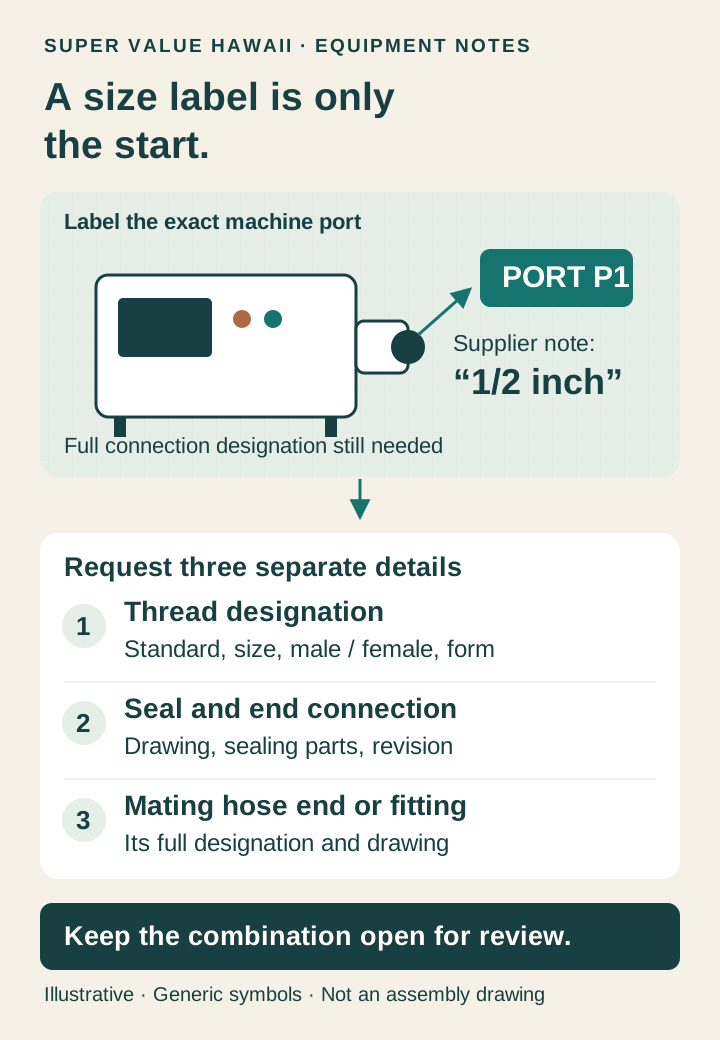
Give each port a location and a drawing reference
Ask for an overall photo with the relevant inlet or outlet labelled, followed by a close-up and the manufacturer’s port drawing. Use a reference such as P1 consistently in the enquiry, drawing and parts list. A close-up without a location can leave two similar ports confused.
Record the machine model, options and drawing revision. Ask whether a quoted connection describes the machine port itself or the end of a hose or adapter supplied with it. Those may be different interfaces.
- One labelled location on the exact machine configuration.
- Full thread callout, including nominal size and the specified pitch or standard.
- Male or female end, and straight or tapered form.
- Manufacturer drawing number, revision and intended mating-part reference.
Ask how the connection seals
Swagelok distinguishes a thread standard from an end-connection standard. Its guide shows that end connections using the same thread family can have different sealing arrangements. Identifying the thread therefore leaves a separate sealing question to answer.
Request the drawing or part reference for the intended mating connection, including any specified gasket, O-ring, cone or other sealing feature. Ask which of these parts the supplier includes. Keep the hose bore, port thread and sealing details in separate fields.
Have the machine manufacturer and the qualified person responsible for the site connection review the proposed components, materials and service conditions. This purchasing record does not select an adapter, pressure rating, tightening method or sealant.
Treat an uncertain identification as an open purchasing item
Swagelok notes that some 1/2- and 3/4-inch ISO 7/1 and NPT threads are difficult to distinguish because their designs are close. Its guide also separates thread identification from identifying the complete end connection.
Send an uncertain identification back for a documented answer. A photo, a diameter estimate or a seller’s “same size” message can support the discussion without closing it. Ask the reviewer to identify what evidence is still needed before ordering the mating parts.
If an adapter is proposed, request its complete designation and drawing, the two interfaces it connects and the person responsible for reviewing the combination. Record any change to the machine-side parts or the work expected in Hawaii.
Keep a record for each connection
Use a separate row set for each labelled port and its proposed mating end. The blank download below is a request record; an empty field remains unresolved. It is not a thread-identification chart or a compatibility approval.
| Review item | Question to record |
|---|---|
| Machine and port | Which model, configuration and drawing revision apply? Where is the labelled port on the machine? |
| Thread callout | What full thread standard and nominal size does the manufacturer specify? |
| Thread form | Is this end male or female, and straight or tapered? What pitch is specified? |
| Seal and end connection | What sealing geometry and parts does the manufacturer require? Which drawing or part reference identifies them? |
| Mating end | What is the complete designation of the hose end or proposed fitting on the other side? |
| Service conditions | What fluid, operating conditions, ratings and material requirements must the responsible technical reviewer check? |
| Supply scope | Which hoses, fittings and sealing parts are included, in what quantities and package IDs? |
| Review result | Who reviewed the combination, on what date, and which questions remain open? |
Record the supplier’s exact designation and evidence. Technical identification and component selection remain with the responsible manufacturer and site reviewer.
Make the connection parts visible in the shipment scope
Once the connection proposal is reviewed, put the agreed hoses, fittings and sealing parts on the supply list with quantities and part references. Identify anything the buyer must obtain separately. Keep revised drawings with the final machine documents.
If these parts come from another supplier, give them their own order lines before arranging supplier consolidation. Confirm where separately packed items will be recorded on the packing list so that the receiver can locate them.
Send Super Value Hawaii the machine offer and the connection questions still open. We can coordinate the equipment and parts enquiry alongside the China-to-Hawaii shipping assessment. The technical connection review and the transport quotation cover different work.
Please label the port on the machine photo and send its full thread designation, sealing arrangement and drawing revision. Also identify the intended mating hose end or fitting, and list the connection parts included in the offer.