
Packing & consolidation
Stacking instructions for equipment crates shipped to Hawaii
Your supplier replies, “Yes, the machine comes in a wooden crate.” That still leaves a question for a shared container shipment to Hawaii: what, if anything, can be placed above it? Ask for stacking instructions tied to the finished package. A lid, a photograph or the word “stackable” leaves out the conditions a loading team needs.
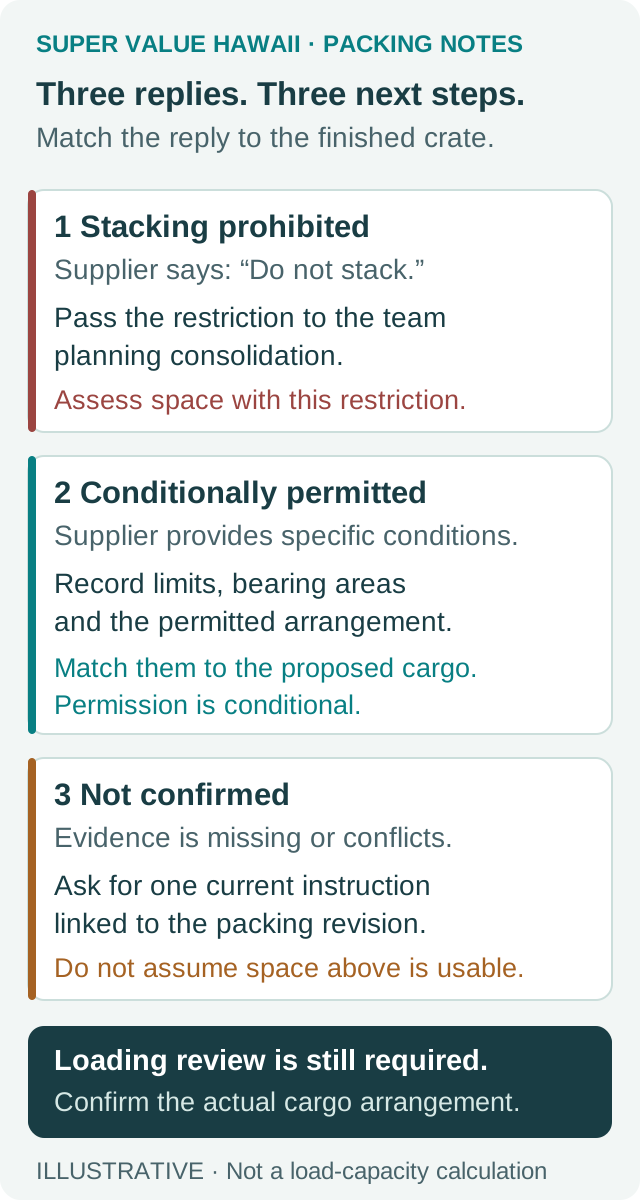
Put the packing into one of three planning states
For the initial cargo list, record one of these states: stacking prohibited, stacking permitted under stated conditions, or stacking not confirmed. These are working labels for coordinating the shipment. They are not a certification or a loading approval.
A supplier's “do not stack” instruction is a clear restriction. Pass it on with the cargo details so the proposed arrangement can be assessed. If the supplier permits stacking, obtain the conditions in writing. If the answer is missing, vague or inconsistent with a label, leave the status unconfirmed and ask for clarification before planning cargo above that package.
This matters when combining orders from multiple suppliers. A crate may occupy little measured volume while still restricting the use of space above it. Its fit within a shared container cannot be settled from CBM alone.
Read what the stacking mark actually limits
The IMO/ILO/UNECE CTU Code distinguishes package marks for a stacking limit by mass, a limit on the number of identical packages permitted above the marked package, and no stacking. Those instructions describe different constraints. A limit expressed as the number of identical packages permitted above it does not establish permission to place a different machine or pallet on top.
Have the supplier send a clear photo of every handling mark and explain it in writing. Record whether the instruction limits a mass above the package, the number of identical packages permitted above it, or prohibits stacking. Keep the units and the exact wording. Do not silently turn a marked limit into a general “stackable: yes.”
The CTU Code is non-mandatory international guidance. The reference below explains the packing principles and marks; it is not a Hawaii-specific permit or a calculation of your crate's safe load.
Ask what must support the load above
Ask the supplier or packing designer to identify where any permitted load must bear. “The crate can take a load” is incomplete if the next package's feet, runners or pallet contact it in different places. Ask for an annotated drawing or photograph showing the intended support areas and the arrangement covered by the instruction.
Also ask whether anything inside or outside the packing prevents that arrangement. A projecting control cabinet, a sloped cover, an exposed component or an opening needed for access can change what the loading team can do. Photos help explain the issue; they do not prove structural capacity.
- Identify the package: machine or order reference, crate number and current packing revision.
- State the permitted stacking arrangement, or confirm that stacking is prohibited.
- Explain any limit on mass or on the number of identical packages above this package, including units and whether it applies only to identical packages.
- Show the specified bearing areas and any required alignment, supports or separators.
- Identify projections, fragile areas and places that must remain clear.
- State any conditions for transport and handling that differ from storage in the supplier's warehouse.
- Provide the final outside dimensions, gross weight and photos of the completed packing and its marks.
The loading team must review those instructions against the proposed cargo and handling arrangement. If structural capacity is unresolved, ask the supplier or a qualified packing designer to resolve it. Do not estimate a safe top load from timber thickness or crate weight.
Resolve conflicting instructions before cargo collection
Consider an illustrative order: the supplier's quotation says “stackable,” the crate photograph shows a no-stacking mark, and a later message says another pallet can go above it. Keep all three records and ask which instruction applies to the finished package. The buyer should not choose the most convenient answer.
Ask the supplier to issue one current written instruction, identify the packing revision and explain the discrepancy. If a mark needs correcting, request a photo after the supplier has corrected it. Send the updated record to the party arranging collection and consolidation, and ask them to acknowledge the revision.
Until that conflict is resolved, the proposed top-loading arrangement remains unconfirmed. If the cargo cannot fit under the confirmed restriction, review a different arrangement or ask the supplier about suitable repacking. Confirm any added work, dimensions, cost and ready date before proceeding.
Recheck the instruction when the packing changes
A stacking instruction belongs to a particular package design and configuration. If the supplier changes the base, frame, cover, attachments or way the machine is secured, ask whether the earlier instruction still applies. Request the answer for the revised packing, even if the order number stays the same.
Keep one cargo-list revision for the final dimensions, gross weight, packing photos and handling instructions. Separate accessory cartons should have their own entries. Send changes before collection or loading so the proposed use of container space can be reviewed again.
Ask the shipping provider which packing and stacking assumptions its offer used. Confirm any revision to the arrangement or price in writing. Non-stackable equipment shipping to Hawaii needs an actual cargo assessment; this article does not establish a surcharge or available container space.
A message to send your equipment supplier
Copy this request and replace the brackets with your order details:
Please confirm the stacking instructions for [machine/order and crate number], packing revision [date/reference], for the proposed ocean shipment to Hawaii. State whether stacking is prohibited or permitted under specific conditions. If permitted, identify what may be placed above, any limit on mass or on the number of identical packages above this package, the required bearing areas and alignment, and any transport or handling restrictions. Please provide the final packed dimensions, gross weight, clear photos of the completed package and all handling marks, plus an annotated drawing if needed to explain the permitted arrangement. If the design or marks have changed, identify which earlier instructions this revision replaces. The shipping team will review the proposed loading arrangement separately.
Save the reply with the final packing list. A chat answer separated from its crate reference can easily be applied to the wrong package.
Send the packing evidence with your Hawaii inquiry
For a China-to-Hawaii consolidation inquiry, send the package list, current instructions and photos together with supplier-ready dates and the destination island and ZIP code. Flag unconfirmed packing details at the start. We can assess the proposed shipment with those limitations visible.
All Hawaiian islands can be considered, with costs and arrangements checked separately. Combining cargo depends on compatibility, readiness and actual available space. Confirm packing restrictions before treating a place in a shared container as settled.