
Farm supplies & packing
Nested harvest baskets: packing dimensions for Hawaii
A supplier quotes the dimensions of one harvest basket. Your Hawaii shipment will contain bundles of empty baskets, each holding several units. For nested harvest baskets, ask for the count and measured height of a complete column before using the figures for a transport estimate. Handles, a base and the final packing can change the outside size.
Identify the arrangement being measured
In a nested column, empty baskets fit partly inside one another. A stack used to hold filled baskets has a different purpose and may use a different orientation or support arrangement. Ask the supplier to demonstrate the packing configuration for the exact model you intend to buy.
Rehrig Pacific, for example, describes one harvest crate as 180-degree stackable/nestable and lists external dimensions and a stack increment separately. Those are details of that named product. They do not identify the configuration or nesting height of a different supplier’s basket.
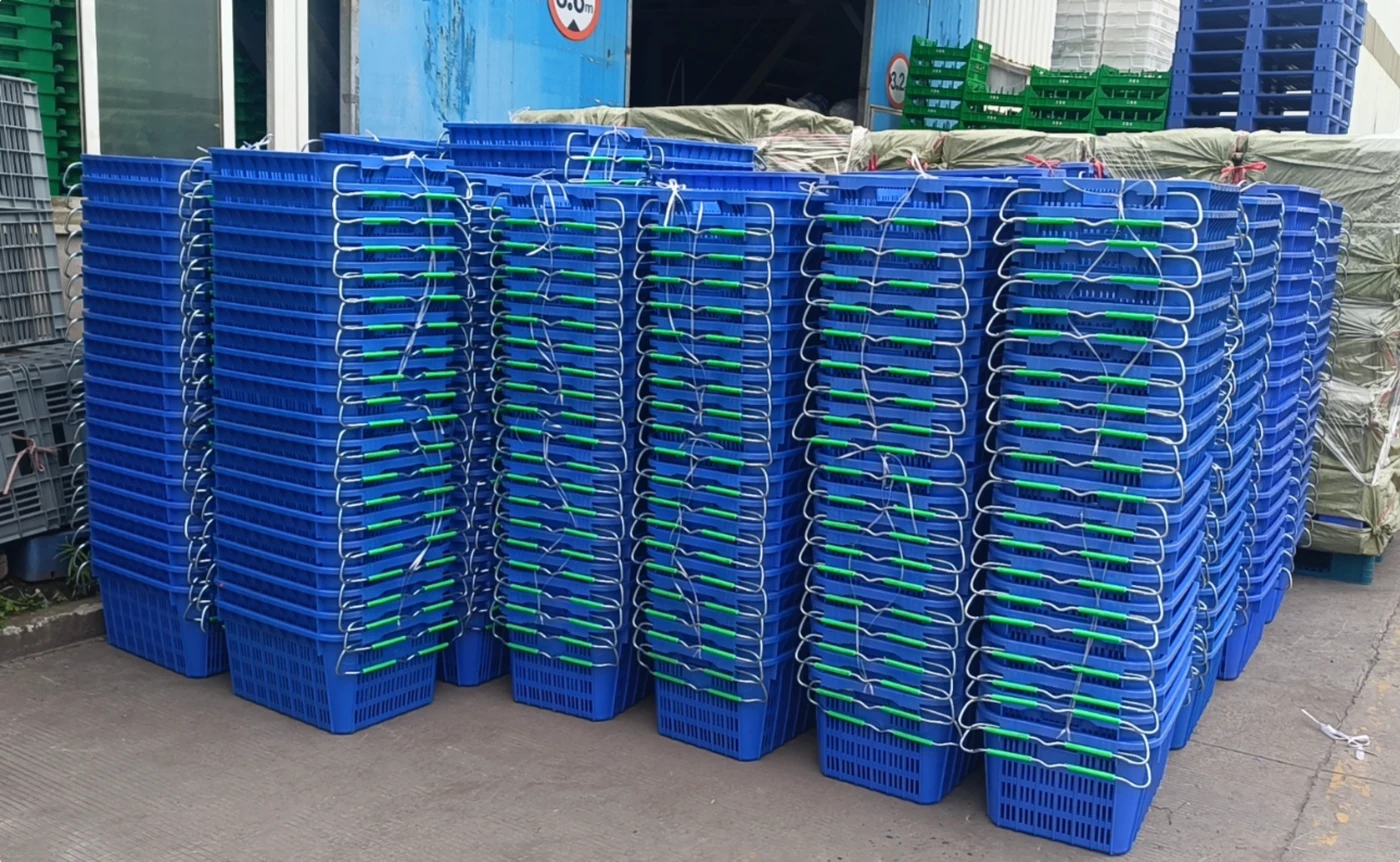
The archived photograph below shows blue baskets arranged in closely nested columns, with metal handles and green grip sleeves visible. Use it to explain the type of packing information you need. Confirm the proposed model and handle position with the supplier; the photo has no measurement scale.
Measure a column with a stated basket count
Request the height of one empty basket and the total height of a column containing a stated number of identical baskets. Have the supplier show both measurements with a tape in the photographs. Record the handle position and any inserts or separators present. A column height without its basket count cannot explain how the bundle was formed.
For a preliminary check, the additional height per nested basket can be estimated from those two measurements: subtract the single-basket height from the column height, then divide by the number of additional baskets. This assumes the same model and a consistent nesting arrangement.
Illustrative arithmetic only: suppose one empty basket is 0.30 m high and a column of 10 measures 0.75 m. The average added height is (0.75 − 0.30) ÷ 9 = 0.05 m. Under that assumption, 20 baskets would have an estimated unwrapped column height of 0.30 + 19 × 0.05 = 1.25 m. These invented measurements do not describe the photographed baskets.
Use that calculation to check an estimate, then request the measured height of the actual proposed bundle. The calculation leaves the pallet or base, protective packing and securing materials to be accounted for. It also provides no permission to build or transport a column at that height.
Keep the product count and shipping-unit count separate
Put the basket quantity and the number of shipping bundles in separate fields. For each bundle, record its basket count and model. The bundle counts should reconcile to the total order quantity; a line reading “20 pcs” needs to say whether it means baskets or bundles.
If sizes, handle options or packing methods differ, ask for separate lines. Do not apply one model’s measured nesting height to another because the baskets look similar. Give a partly filled final bundle its own count and dimensions.
Keep the supplier’s instructions for loaded use, load limits and handling with the product specification. Those instructions answer different questions from the dimensions of empty baskets prepared for shipment.
Measure again after the bundle is finished
Ask for the maximum outside length, width and height of each completed shipping unit. Include any base, projecting handles, protection and materials used to secure the bundle. Record gross weight for that same unit. Leave preliminary figures labelled as estimates until the packing is complete.
Have the supplier identify the bundle in its packing record and send overall photographs with the final count. Pass the packing provider’s handling and stacking restrictions to the transport team. Avoid changing the packing simply to reproduce a smaller estimate.
When combining orders from multiple suppliers, retain each supplier’s bundle references in the combined cargo list. Nesting reduces the space occupied by the empty baskets within a bundle; the complete shipment still needs review for handling, cargo suitability and actual space.
Use one record for each distinct bundle
Collect the following information before asking for a Hawaii transport assessment. If several finished bundles are identical, record the number of those bundles explicitly.
| Review item | Question to record |
|---|---|
| Basket model and configuration | Which exact model, handle arrangement and packing revision do these measurements cover? |
| Count and unit | How many baskets are in each bundle, how many bundles are shipping, and how do they reconcile to the order quantity? |
| Nesting measurement | What is the height of one empty basket and of a measured column containing a stated count? Are these preliminary or final figures? |
| Finished shipping envelope | What are the maximum outside length, width and height after the base, protection and securing materials are added? |
| Gross weight | What is the gross weight of each finished shipping unit, with its basket count and packing included? |
| Package reference and readiness | Which bundle reference, dated photos and packing-list revision identify this unit, and is it ready for collection? |
The worksheet records purchasing and transport inputs. Final packing, permitted handling and any loaded-use limits require confirmation for the actual product and shipment.
Send a focused measurement request
Once the basket model and order quantity are agreed, ask the supplier for a measured packing proposal:
For [basket model and order reference], please state the number of baskets in each shipping bundle and the total bundle count. Show the measured height of one empty basket and of a column with a stated count, including the handle position. Please provide the finished bundle’s maximum outside dimensions, gross weight and identifying reference, with dated photos. Mark estimates separately from final packed measurements and include the packing and handling instructions.
Bring the packing proposal to the Hawaii review
For a Super Value Hawaii sourcing and shipping assessment, send the basket offer, packing record and photos together. Include the destination island and ZIP code, plus any receiving constraints. If you already have other suppliers, list their cargo and readiness separately.
Supplier consolidation depends on cargo fit, readiness and actual space. Each island’s handover arrangement and costs need separate review. A nesting calculation helps describe the order; final packed figures support the shipment assessment.